

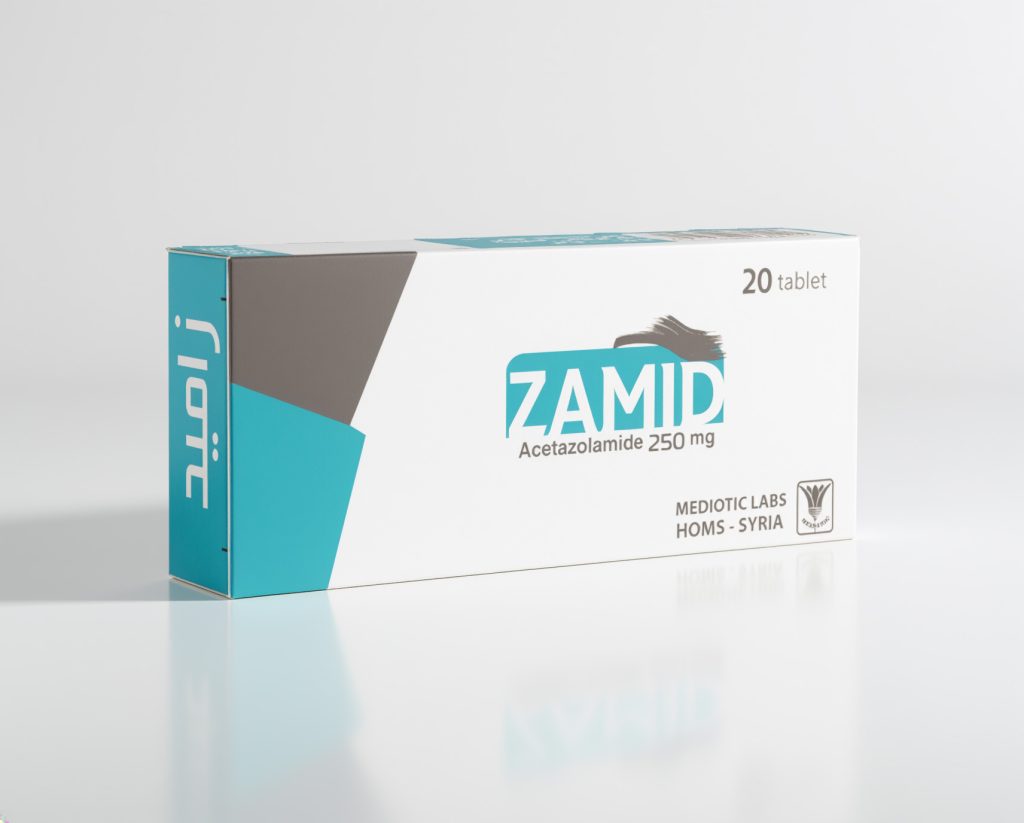
ZAMID
Composition : Acetazolamid 250 mg
Pharmaceutical Forms : Tablets
Usage : Ocular hypotensive, diuretic
COMPOSITION: Each tablet contains:250 mg Acetazolamide.
EXCIPIENTS:Lactose monohydrate, Sodium starch glycolate, corn starch and calcium stearate.
MECHANISM OF ACTION: Acetazolamide is an enzyme inhibitor that acts specifically on carbonic anhydrase. this inhibitory action of Acetazolamide decreases the secretion of aqueous humor and results in a drop in intraocular pressure, a reaction considered desirable in cases of glaucoma and even in certain non-glaucomatous conditions.
The diuretic effect of Acetazolamide is due to its action in the kidney on the reversible reaction involving hydration of carbon dioxide and dehydration of carbonic acid.
INDICATIONS:
For adjunctive treatment of: edema due to congestive heart failure; drug-induced edema; centrencephalic epilepsies (petit mal, unlocalized seizures); chronic simple (open-angle) glaucoma, secondary glaucoma, and preoperatively in acute angle-closure glaucoma where delay of surgery is desired in order to lower intraocular pressure. Acetazolamideis also indicated for the prevention or amelioration of symptoms associated with acute mountain sickness in climbers attempting rapid ascent and in those who are very susceptible to acute mountain sickness despite gradual ascent.
Abnormal retention of fluids: ACETAZOLAMIDE Tablets can be used in conjunction with other diuretics when effects on several segments of the nepbron are desirable in the treatment of fluid retaining states.
CONTRAINDICATIONS:
Acetazolamidetherapy is contraindicated in situations in which sodium and/or potassium blood serum levels are depressed, in cases of marked kidney and liver disease or dysfunction, in suprarenal gland failure, and in hyperchloremia acidosis. It is contraindicated in patients with cirrhosis because of the risk of development of hepatic encephalopathy.
Long-term administration of Acetazolamideis contraindicated in patients with chronic noncongestive angle-closure glaucoma since it may permit organic closure of the angle to occur while the worsening glaucoma is masked by lowered intraocular pressure.
ACETAZOLAMIDE tablets should not be used in patients hypersensitive to sulphonamides.
WARNING:
Fatalities have occurred, although rarely, due to severe reactions to sulfonamides including Stevens-Johnson syndrome,
toxic epidermal necrolysis, fulminant hepatic necrosis, agranulocytosis, aplastic anemia, and other blood dyscrasias. Sensitizations may recur when a sulfonamide is readministered irrespective of the route of administration. If signs of hypersensitivity or other serious reactions occur, discontinue use of this drug. Caution is advised for patients receiving concomitant high-dose aspirin and Acetazolamide,
as anorexia, tachypnea, lethargy, coma and death have been reported.
Suicidal ideation and behavior have been reported in patients treated with anti-epileptic agents in several indications.
Therefore patients should be monitored for signs of suicidal ideation and behaviors and appropriate treatment should be considered. Patients (and caregivers of patients) should be advised to seek medical advice should signs of suicidal ideation or behavior emerge.
When ACETAZOLAMIDE tablets is prescribed for long-term therapy, special precautions are advisable. The patient should be cautioned to report any unusual skin rash. Periodic blood cell counts and electrolyte levels are recommended.
In patients with pulmonary obstruction or emphysema where alveolar ventilation may be impaired, ACETAZOLAMIDE tablets may aggravate acidosis and should be used with caution. In patients with a past history of renal calculi, benefit should be balanced against the risks of precipitating further calculi. The occurrence at the treatment initiation of a feverish generalized erythema associated with pustula may be a symptom of acute generalised exanthematous pustulosis (AGEP). In case of AGEP diagnosis, Acetazolamide should be discontinued and any subsequent administration of acetazolamide contraindicated.
PRECAUTIONS:
General: Increasing the dose does not increase the diuresis and may increase the incidence of drowsiness
and/or paresthesia. Increasing the dose often results in a decrease in diuresis. Under certain circumstances, however, very large doses have been given in conjunction with other diuretics in order to secure diuresis in complete refractory failure.
Laboratory Tests: To monitor for hematologic reactions common to all sulfonamides, it is recommended that a baseline CBC and platelet count be obtained on patients prior to initiating Acetazolamide therapy and at regular intervals during therapy. If significant changes occur, early discontinuance and institution of appropriate therapy are important. Periodic monitoring of serum electrolytes is recommended. PREGNANCY: Pregnancy Category C
There are no adequate and well-controlled studies in pregnant women.
Acetazolamide should be used in pregnancy only if the potential benefit justifies the potential risk to the fetus. Acetazolamide tablets should not be used in pregnancy, especially during the first trimester.
NURSING MOTHERS: Because of the potential for serious adverse reactions in nursing infants from Acetazolamide, a decision should be made whether to discontinue nursing or to discontinue the drug taking into account the importance of the drug to the mother. PEDIATRIC USE:
The safety and effectiveness of Acetazolamide in children have not been established.
Effects on ability to drive and use machines:
Increasing the dose does not increase the diuresis and may increase the incidence of drowsiness and/or paraesthesia. Less commonly, fatigue, dizziness and ataxia have been reported. Disorientation has been observed in a few patients with oedema due to hepatic cirrhosis. Such cases should be under close supervision. Transient myopia has been reported. These conditions invariably subside upon diminution or discontinuance of the medication.
ADVERSE REACTIONS:
Adverse reactions, occurring most often early in therapy, include paresthesias, particularly a “tingling” feeling in the extremities, hearing dysfunction or tinnitus, loss of appetite, taste alteration and gastrointestinal disturbances such as nausea, vomiting and diarrhea, polyuria, and occasional instances of drowsiness and confusion.
Metabolic acidosis and electrolyte imbalance may occur.
Transient myopia has been reported. This condition invariably subsides upon diminution or discontinuance of the medication. Other occasional adverse reactions include urticaria, melena, hematuria, glycosuria, hepatic insufficiency, flaccid paralysis, photosensitivity and convulsions.
DRUG INTERACTIONS:
Acetazolamide is a sulphonamide derivative. Sulphonamides may potentiate the effects of folic acid antagonists. Possible potentiation of the effects of folic acid antagonists, hypoglycaemics and oral anti-coagulants may occur. Concurrent administration of acetazolamide and aspirin may result in severe acidosis and increase central nervous system toxicity. Adjustment of dose may be required when ACETAZOLAMIDE tablets is given with cardiac glycosides or hypertensive agents.
When given concomitantly, acetazolamide modifies the metabolism of phenytoin, leading to increased serum levels of phenytoin. Severe osteomalacia has been noted in a few patients taking acetazolamide in combination with other anticonvulsants. There have been isolated reports of reduced primidone and increased carbamazepine serum levels with concurrent administration of Acetazolamide.
Because of possible additive effects, concomitant use with other carbonic anhydrase inhibitors is not advisable. By increasing the pH of renal tubular urine, Acetazolamide reduces the urinary excretion of amphetamine and quinidine and so may enhance the magnitude and the duration of effect of amphetamines and enhance the effect of quinidine.
Ciclosporin: Acetazolamide may elevate ciclosporin levels.
Related Products.
- New
ABILY 30
- New
BROMHEXINE
- New
Xarivan 2.5
- New
Xarivan 5
- New
TOPIMATE 200
- New