

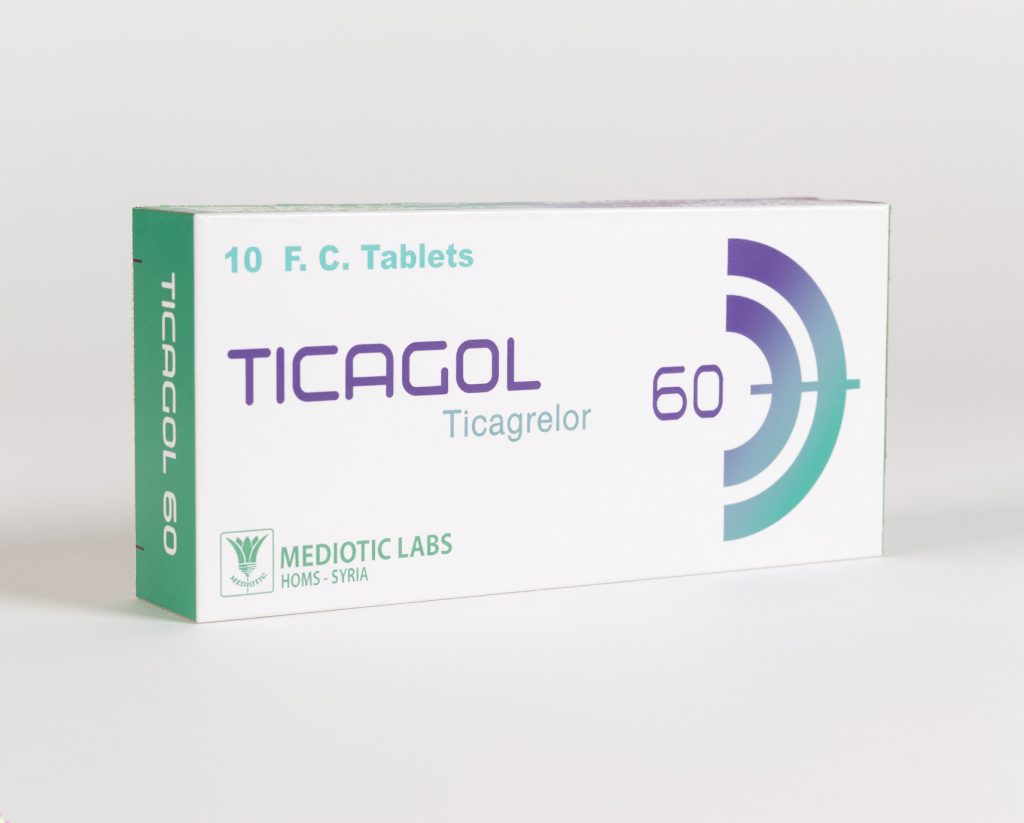
TICAGOL 60
Composition : Ticagrelor 60 mg
Pharmaceutical Forms : Tablets
Usage : Anticoagulant
Bleeding Risk:
- Ticagrelor, like other antiplatelets agents, can cause significant, sometimes fatal bleeding.
- Do not use Ticagrelor in patients with active pathological bleeding or a history of intracranial hemorrhage.
- Do not start using Ticagrelor in patients planned to undergo urgent coronary artery bypass graft surgery (CABG). When possible, discontinue Ticagrelor at least 5 days prior to any surgery.
- Suspect bleeding in any patient who is hypotensive and has recently undergone coronary angiography, percutaneous coronary intervention (PCI), CABG, or other surgical procedures in case of using Ticagrelor.
- If possible, manage bleeding without discontinuing Ticagrelor. Stopping Ticagrelor increase the risk of subsequent cardiovascular events.
- Do not stop taking Ticagrelor without talking to your doctor.
Aspirin dose and Ticagrelor effectiveness:
- Maintenance doses of aspirin above 100 mg reduce the effectiveness of Ticagrelor and should be avoided. After any initial dose, use with Aspirin 75-100 mg per day.
PHARMACOLOGICAL PROPERTIES:
Mechanism of Action:
Ticagrelor and its major metabolites reversibly interact with the platelets P2Y 12 ADP-receptor to prevent signal transduction and platelets activation. Ticagrelor and its active metabolites are approximately equipotent.
Pharmacodynamics:
The maximum IPA (The inhibition of platelets aggregation) effect of Ticagrelor was reached at around 2 hours, and was maintained for at least 8 hours. Pharmacokinetics:
Absorption:
The mean absolute bioavailability of Ticagrelor is about 36%, (range 30%-42%). Ingestion of a high-fat meal had no effect on Ticagrelor Cmax, but resulted in a 21% increase in AUC. The Cmax of its major metabolite was decreased by 22% with no change in AUC. TICAGRELOR can be taken with or without food.
Distribution:
The steady state volume of distribution of Ticagrelor is 88 L. Ticagrelor and the active metabolite are extensively bound to human plasma proteins (>99%).
Metabolism:
CYP3A4 is the major enzyme responsible for Ticagrelor metabolism and the formation of its major active metabolite. Ticagrelor and its major active metabolite are weak P-glycoprotein substrates and inhibitors. The systemic exposure to the active metabolite is approximately 30-40% of the exposure of Ticagrelor.
Excretion:
The primary route of Ticagrelor elimination is hepatic metabolism.
The primary route of elimination for the major metabolite of Ticagrelor is most likely to be biliary secretion. The mean t1/2 is approximately 7 hours for Ticagrelor and 9 hours for the active metabolite. INDICATIONS:
Acute Coronary Syndromes:
TICAGRELOR is a P2Y12 platelets inhibitor indicated to reduce the rate of thrombotic cardiovascular events in patients with acute coronary syndrome (ACS) (unstable angina, non-ST elevation myocardial infarction, or ST elevation myocardial infarction). TICAGRELOR has been shown to reduce the rate of a combined endpoint of cardiovascular death, myocardial infarction or stroke compared to Clopidogrel. In patients treated with PCI, it also reduces the rate of stent thrombosis.
TICAGRELOR has been studied in ACS in combination with Aspirin. Maintenance doses of Aspirin above 100 mg decreased the effectiveness of TICAGRELOR. Avoid maintenance doses of Aspirin above 100 mg daily.
CONTRAINDICATIONS:
History of Intracranial Hemorrhage:
TICAGRELOR is contraindicated in patients with a history of intracranial hemorrhage (ICH) because of the high risk of recurrent ICH in this population.
Active Bleeding:
TICAGRELOR is contraindicated in patients with active pathological bleeding such as peptic ulcer or intracranial hemorrhage. Severe Hepatic Impairment:
TICAGRELOR is contraindicated in patients with severe hepatic impairment because of a probable increase in exposure, and it has not been studied in these patients. Severe hepatic impairment increases the risk of bleeding because of reduced synthesis of coagulation proteins.
Hypersensitivity:
TICAGRELOR is contraindicated in patients with hypersensitivity (e.g. angioedema) to ticagrelor or any component of the product. ADVERSE REACTIONS:
- Bleeding:
Major bleeding – fatal/life-threatening: Any one of the following: fatal; intracranial; intrapericardial bleeding with cardiac tamponade; hypovolemic shock or severe hypotension due to bleeding and requiring pressors or surgery; clinically overt or apparent bleeding associated with a decrease in hemoglobin (Hb) of more than 5 g/dL; transfusion of 4 or more units (whole blood or packed red blood cells (PRBCs)) for bleeding.
Major bleeding – other: Any one of the following: significantly disabling (e.g., intraocular bleeding with permanent vision loss); clinically overt or apparent bleeding associated with a decrease in Hb of 3 g/dL; transfusion of 2-3 units (whole blood or PRBCs) for bleeding.
Minor bleed: Requires medical intervention to stop or treat bleeding (e.g., epistaxis requiring visit to medical facility for packing).
Minimal bleeding: All others (e.g., bruising, bleeding gums, oozing from injection sites, etc.) not requiring intervention or treatment.
- Non-hemorrhagic adverse events:
Dyspnea, headache, cough, dizziness, nausea, atrial fibrillation, hypertension, non-cardiac chest pain, diarrhea, back pain, hypotension, fatigue, chest pain, bradycardia, gynecomastia.
- Lab abnormalities:
Increased levels of serum uric acid, increased serum creatinine levels.
WARNINGS & PRECAUTIONS:
General Risk of Bleeding:
Drugs that inhibit platelets function including TICAGRELOR increase the risk of bleeding. TICAGRELOR increased the overall risk of bleeding (Major + Minor) to a somewhat greater extent than did Clopidogrel. The increase was seen for non CABG-related bleeding, but not for CABG-related bleeding. Fatal and life-threatening bleeding rates were not increased.
In general, risk factors for bleeding include aging, a history of bleeding disorders, performance of percutaneous invasive procedures, and concomitant use of medications that increase the risk of bleeding (e.g., anticoagulant and fibrinolytic therapy, higher doses of Aspirin, and chronic nonsteroidal anti-inflammatory drugs [NSAIDS]).
When possible, discontinue TICAGRELOR five days prior to surgery. Suspect bleeding in any patient who is hypotensive and has recently undergone coronary angiography, PCI, CABG, or other surgical procedures, even if the patient does not have any signs of bleeding.
If possible, manage bleeding without discontinuing TICAGRELOR. Stopping TICAGRELOR increases the risk of subsequent cardiovascular events.
Concomitant Aspirin Maintenance Dose:
Use of TICAGRELOR with maintenance doses of Aspirin above 100 mg decreased the effectiveness of TICAGRELOR. Therefore, after the initial loading dose of Aspirin (usually 325 mg), use TICAGRELOR with a maintenance dose of Aspirin of 75-100 mg. Moderate Hepatic Impairment:
TICAGRELOR has not been studied in patients with moderate hepatic impairment. Consider the risks and benefits of treatment, noting the probable increase in exposure to Ticagrelor. Dyspnea:
Dyspnea was reported in 14% of patients treated with TICAGRELOR and in 8% of patients taking Clopidogrel. Dyspnea was usually mild to moderate in intensity and often resolved during continued treatment, but occasionally required discontinuation (0.9% of patients taking TICAGRELOR versus 0.1% of patients taking Clopidogrel). If a patient develops new, prolonged, or worsened dyspnea during treatment with TICAGRELOR, exclude underlying diseases that may require treatment. If dyspnea is determined to be related to TICAGRELOR, no specific treatment is required; continue TICAGRELOR without interruption. In the case of intolerable dyspnea requiring discontinuation of TICAGRELOR, consider prescribing another antiplatelets agent.
Discontinuation of TICAGRELOR:
Avoid interruption of TICAGRELOR treatment. If TICAGRELOR must be temporarily discontinued (e.g., to treat bleeding or for elective surgery), restart it as soon as possible. Discontinuation of TICAGRELOR will increase the risk of myocardial infarction, stent thrombosis, and death.
Strong Inhibitors of Cytochrome CYP3A:
Ticagrelor is metabolized by CYP3A4/5. Avoid use with strong CYP3A inhibitors, such as Atazanavir, Clarithromycin, indinavir, Itraconazole, ketoconazole, Nefazodone, Nelfinavir, Ritonavir, Saquinavir, Telithromycin and Voriconazole.
Cytochrome CYP3A Potent Inducers:
Avoid use with potent CYP3A inducers, such as Rifampin, Dexamethasone, Phenytoin, Carbamazepine, and Phenobarbital. DRUG INTERACTIONS:
- Effects of other drugs:
Ticagrelor is predominantly metabolized by CYP3A4 and to a lesser extent by CYP3A5. Ticagrelor is also a p-glycoprotein (P-gp) substrate.
Strong CYP3A inhibitors:
Avoid use of strong inhibitors of CYP3A (e.g., Ketoconazole, Itraconazole, Voriconazole, Clarithromycin, Nefazodone, Ritonavir, Saquinavir, Nelfinavir, Indinavir, Atazanavir and Telithromycin).
Strong CYP3A inducers:
Avoid use with potent inducers of CYP3A (e.g., Rifampin, Phenytoin, Carbamazepine and Phenobarbital). Aspirin:
Use of TICAGRELOR with Aspirin maintenance doses above 100 mg reduced the effectiveness of TICAGRELOR.
- Effect of TICAGRELOR on other drugs:
Ticagrelor is an inhibitor of CYP3A4/5 and the P-glycoprotein transporter.
Simvastatin, Lovastatin :
TICAGRELOR will cause an increase at serum concentrations of Simvastatin and Lovastatin because these drugs are metabolized by CYP3A4. Avoid Simvastatin and Lovastatin doses greater than 40 mg.
Digoxin :
Because of inhibition of the P-glycoprotein transporter, monitor Digoxin levels with initiation of or any change in TICAGRELOR therapy.
- Other Concomitant Therapy
TICAGRELOR can be administered with unfractionated or low-molecular-weight heparin, GPIIb/Illa inhibitors, proton pump inhibitors, beta-blockers, angiotensin converting enzyme inhibitors, and angiotensin receptor blockers. PREGNANCY & LACTATION:
Pregnancy Category C:
There are no adequate and well-controlled studies of TICAGRELOR use in pregnant women. In animal studies, Ticagrelor caused structural abnormalities at maternal doses about 5 to 7 times the maximum recommended human dose (MRHD) based on body surface area. TICAGRELOR should be used during pregnancy only if the potential benefit justifies the potential risk to the fetus. Lactation:
It is not known whether Ticagrelor or its active metabolites are excreted in human milk. Ticagrelor is excreted in rat milk. Because many drugs are excreted in human milk, and because of the potential for serious adverse reactions in nursing infants from TICAGRELOR, a decision should be made whether to discontinue nursing or to discontinue drug, taking into account the importance of the drug to the mother.
PEDIATRIC USE:
The safety and effectiveness of TICAGRELOR in pediatric patients have not been established.
GERIATRIC USE:
The relative risk of bleeding is similar in patients over 65 years and people over 75 years. However, excessive sensitivity cannot be ruled out by some elderly people.
HEPATIC IMPAIRMENT:
TICAGRELOR has not been studied in patients with moderate or severe hepatic impairment. Ticagrelor is metabolized by the liver and impaired hepatic function can increase risks for bleeding and other adverse events. Hence, TICAGRELOR is contraindicated in patients with severe hepatic impairment and its use should be considered carefully in patients with moderate hepatic impairment. No dosage adjustment is needed in patients with mild hepatic impairment.
RENAL IMPAIRMENT:
No dosage adjustment is needed in patients with renal impairment. Patients receiving dialysis have not been studied. DOSAGE AND ADMINISTRATION:
Initiate TICAGRELOR treatment with a 180 mg (two 90 mg tablets) loading dose and continue treatment with 90 mg twice daily. during the first year after an ACS event.
After one year administer 60mg twice daily. Don’t administer Ticagrelor with another oral P2Y12 platelet inhibitor. After the initial loading dose of aspirin (usually 325 mg), use TICAGRELOR with a daily maintenance dose of Aspirin of 75 – 100 mg. A patient who misses a dose of TICAGRELOR should take one 90 mg tablet (at the next dose) at its scheduled time. OVERDOSAGE:
There is currently no known treatment to reverse the effects of TICAGRELOR, and Ticagrelor is not expected to be dialyzable. Treatment of overdose should follow local standard medical practice. Bleeding is the expected pharmacologic effect of overdosing. If bleeding occurs, appropriate supportive measures should be taken.
Other effects of overdosage may include gastrointestinal effects (nausea, vomiting, diarrhea) or ventricular pauses. Monitor the ECG. Packaging: 3 blisters, each contains 10 film-coated tablets/carton box.
1 blisters, each contains 10 film-coated tablets/carton box.
Storage Conditions: “Store at room temperature, 15° – 30° C”
Related Products.

- New
ATENOTEC 50/12.5
- New
ABILY 5
- New
HYDRAMINE
- New
ATAX
- New
INDELOL 40
- New