

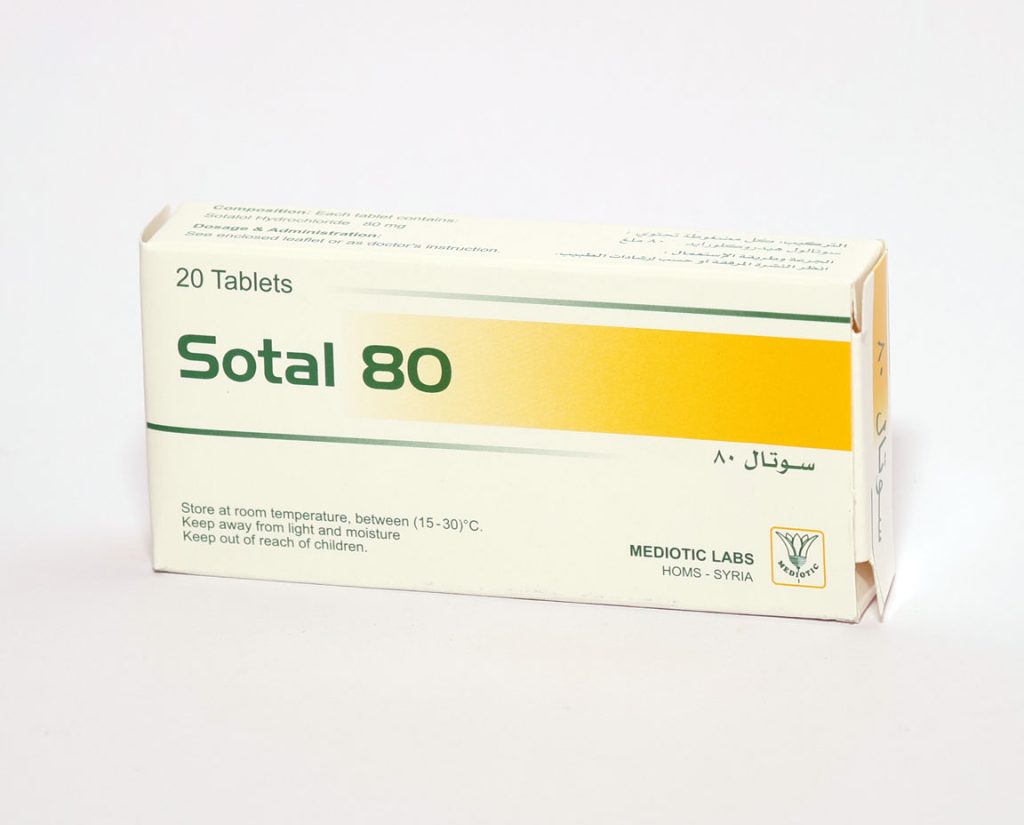
SOTAL 80
Composition : Sotalol Hcl 80mg
Pharmaceutical Forms : Tablets
Usage : Beta blocker, treatment of high blood pressure
Pharmacokinetics:
– Sotalol Hydrochloride is completely absorbed from the gastro-intestinal tract. Peak plasma concentrations are obtained about 2 to 4 hours after a dose. It has low lipid solubility, very little is metabolised and it is excreted unchanged in urine.
– Sotalol Hydrochloride binds to plasma proteins in small percentages, passing the then dispersing into mother’s milk. Indications:
-Sotal is used in the management of ventricular and supraventricular arrhythmias (ventricular tachyarrhythmias, non- sustained ventricular tachyarrhythmias).
Prophylaxis of paroxysmal aterial tachycardia, fibrillation, paroxysmal supraventricular tachycardia after cardiac surgery, and maintenance of sinus rhythm following cardioversion.
In treatment of hypertension and angina pectoris and in thyrocele after your doctor consultation.
Contra-Indications:
-Patients with bronchospasm or asthma.
Sinus bradycardia.
Atrioventricular block (second or third degree).
– Patients with renal failure or Patients with congestive heart failure can’t be controlled.
– Patients with asymptomatic ventricular arrhythmias.
– Congenital or acquired long QT syndrome (torsades de pointes).
– Pregnancy.
Sensitivity to Sotalol Hydrochloride.
Side effects:
Bradycardia, bronchospasm, fatigue, coldness of the extremities, myasthenia, Hypotension, dizziness, sleep disturbances, nausea, skin rash and pruritus, rarely agranulocytosis, and it has arrhythmogenic effect. Precautions:
– The dose may need to be reduced in patients with renal dysfunction.
– Patients on long-term treatment with Sotal should have their medication discontinued gradually over a period of 1-2 weeks.
Serum electrolyte concentrations should be monitored before and during treatment with Sotal.
– The QT interval should be monitored and extreme caution is required if the QT interval exceeds 0.5 second, and Sotal should be discontinued or the dose reduced if the QT interval exceeds 0.55 second.
– It must be taken with caution by patients with: ill sinus node syndrome, new cardiac infarction, thyroid gland disturbances, and diabetes.
It’s not recommended for nursing-mothers for it has been reported to be present in human milk.
Drug Interactions:
– Sotal should not be given concurrently with other drugs that prolong the QT interval due to the increased risk of precipitating ventricular arrhythmias.
– Sotal should not be given with amiodarone, disopyramide, procainamide, quinidine, phenothiazine, astemizole, and erythromycin.
Sotal may potentiate bradycardia due to digoxin.
– Sotal should not be given with drugs that cause electrolyte disturbances such as diuretics.
Dosage & Administration:
– Initiation of Sotal treatment should be in hospital with suitable monitoring facilities.
The QT interval is monitored before the treatment and whenever the dosage is adjusted. Dosage to be determined according to patient’s response.
– Dosage is increased gradually allowing two or three days between dosing increments.
Suggested initial dose is 80 mg daily as a single dose or in two divided doses.
– Most patients respond to doses of 240 mg to 320 mg daily. (Usually given in two divided doses 120-160mg).
Some patients may require doses as high as 460 mg.
– Dose of 80-120 mg daily in treatment of hypertension.
STORAGE CONDITIONS:
– Store at room temperature, between (15-30) °C.
– Keep away from light and moisture
– Keep out of reach of children.
Presentation:
– 2 blisters, each one contains 10 white tablets Sotal 80 / carton box.
– 2 blisters, each one contains 10 pink tablets Sotal 120/carton box.
Related Products.
- New
Xarivan 5
- New
RESTERON 15
- New
EXOZIDE 160/25
- New
RESTERON 5
- New
TOPIMATE 100
- New