

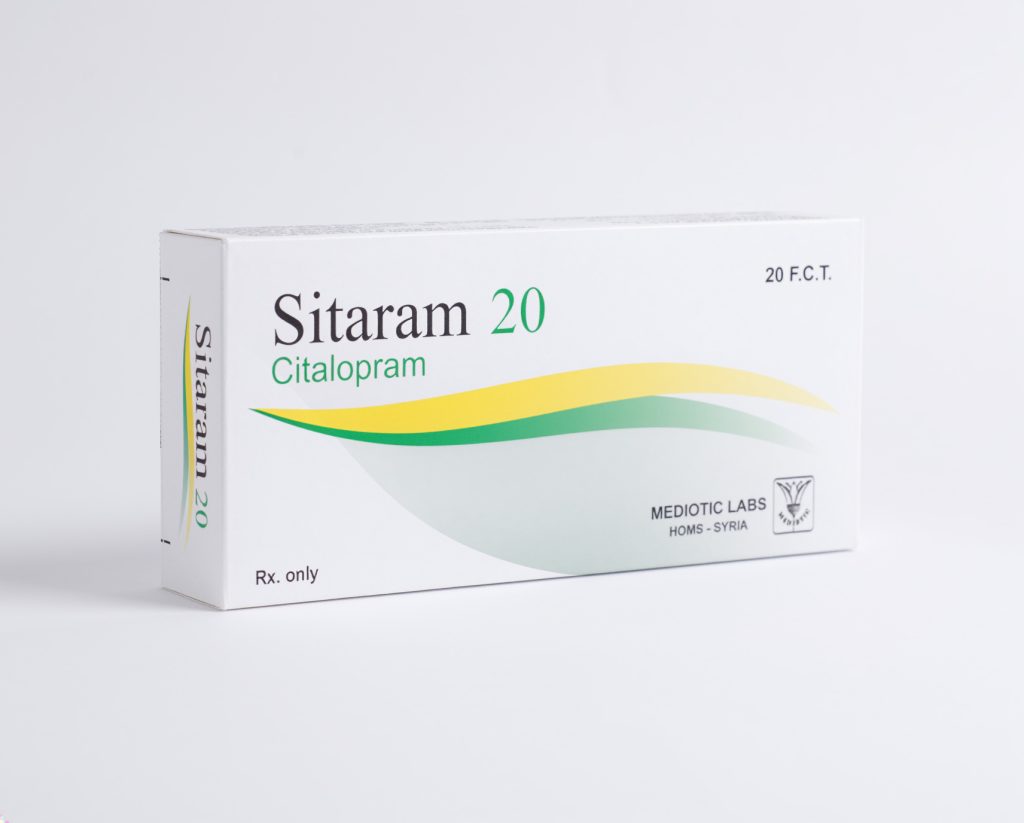
SITARAM 20
Composition : Citalopram HBr 20 mg
Pharmaceutical Forms : Tablets
Usage : Antidepressant
Sitaram (Citalopram HBr) is an orally administered selective serotonin re-uptake inhibitor (SSRI) with a chemical structure unrelated to that of other (SSRI’s) or other available antidepressant agents.
Clinical Pharmacology:
The mechanism of action of Sitaram as an antidepressant is presumed to be linked to potentiation of serotonergic activity in the central nervous system resulting from its inhibition of CNS neuronal reuptake of serotonin (5-HT).
Citalopram has very low affinity for 5-HT, A, 5-HT2 A, dopamine D1 and D2, a1, a2 and ẞ adrenergic, histamine H1, gamma amino butyric acid (GABA), muscarinic, cholinergic and benzodiazepine receptors.
Indications and Usage:
Sitaram is indicated for the treatment of depression. The efficacy of product in the treatment of depression was established in 4 to 6 weeks.
A major depressive episode implies a prominent and relatively persistent (nearly every day for at least 2 weeks) depressed or dysphoric mood that usually interferes with daily functioning, and includes at least 5 of the following 9 symptoms: Depressed mood, loss of interest in usual activities, significant change in weight and/ or appetite, insomnia or hypersomnia, psychomotor agitation or retardation, increased fatigue, feelings of guilt or worthlessness, slowed thinking or impaired concentration, and a suicide attempt or suicidal ideation.
Contraindications:
Sitaram is contraindicated in patients with a hypersensitivity to citalopram or any of the inactive ingredients in Sitaram.
Sitaram is contraindicated in patients taking monoamine oxidase inhibitors.
Similarly, at least 14 days should be allowed after stopping Sitaram before starting an (MAOI).
Precautions:
Several cases of hyponatremia have been reported in association with Sitaram treatment. All patients with these events have recovered with discontinuation of Sitaram.
Sitaram should be used cautiously in patients with a history of mania, history of seizure disorders.
Patients should be cautioned about operating machinery, including automobiles.
Caution is advisable in using Sitaram in patients with diseases or conditions that produce
altered metabolism or hemodynamic responses.
The use of Sitaram in hepatically impaired patients or in patients with a heart disease should
be approached with caution and a lower maximum dosage is recommended.
Sitaram should be used with caution in patients with severe renal impairment.
The concomitant use of Sitaram and alcohol in depressed patients is not advised.
The possibility of a suicide attempt is inherent in depression.
Patients should be advised to notify their physician if they become pregnant, or if they are breast-feeding an infant during therapy.
While patients may notice improvement with Sitaram therapy in 1 to 4 weeks, they should be advised to continue therapy as directed.
Drug Interactions:
Caution should be taken when Sitaram is taken in combination with other centrally acting drugs, with cimetidine, lithium, carbamazepine, ketoconazole, fluconazole, itraconazole, erythromycin, tricyclic antidepressants like imipramine.
Adverse Reactions:
Cardiovascular disorders: tachycardia and hypotension.
Central and peripheral nervous system disorders: migraine, paresthesia.
Gastrointestinal disorders: Saliva increased, flatulence.
Metabolic and Nutritional disorders: Decreased weight, or increased weight.
Psychiatric disorders: impaired concentration, amnesia, apathy, increased appetite, and confusion. Coughing, rash, pruritis, abnormal accommodation and polyuria.
Pharmacokinetics:
Biotransformation of Citalopram is mainly hepatic, with a mean terminal half-life of about 35 hours. With once daily dosing, steady state plasma concentrations are achieved within approximately one week.
At steady state, the extent of accumulation of citalopram in plasma, based on the half-life, is expected to be 2.5 times the plasma concentrations observed after a single dose.
Following a single oral dose of citalopram, peak blood levels occur at about 4 hours. The absolute bioavailability of citalopram was about 80% relative to an intravenous dose, and absorption is not affected by food.
The volume of distribution is about 12 L/Kg, and the binding to human plasma proteins is about 80%.
Citalopram is metabolized to demethylcitalopram (DCT), didemethylcitalopram (DDCT), Citalopram-N-oxide, and a deaminated propionic acid derivative.
In human, unchanged Citalopram is the predominant compound in plasma.
Dosage and administration:
Sitaram should be administered at an initial dose of 20 mg once daily, generally with an increase to a dose of 40 mg/day.
Dose increases should usually occur in increments of 20 mg at intervals of no less than one week. Doses above 40 mg are not ordinarily recommended.
The physician could increase the daily dose to 60mg in some special cases.
Sitaram should be administered once daily, in the morning or evening, with or without food.
20 mg/day is the recommended dose for most elderly patients and patients with hepatic impairment.
The efficacy of Sitaram in maintaining an antidepressant response for up to 24 weeks following 6 to 8 weeks of acute treatment was demonstrated. Nevertheless the physician who elects to use Sitaram for extended periods should periodically re-evaluate the long-term use fullness of the drug for the individual patient.
Over Dosage:
Establish and maintain an airway to ensure adequate ventilation and oxygenation.
Gastric evacuation by lavage and use of activated charcoal should be considered.
Careful observation and cardiac and vital sign monitoring are recommended. Presentation:
Each box of Sitaram 20 contains 20 pink film-coated tablets.
Each box of Sitaram 40 contains 20 white film-coated tablets.
Related Products.
- New
GLYCOMINE
- New
PREVERSIL EXTRA 5/5/1.25
- New
MIGRAMAT
- New
ATENOTEC 50/12.5
- New
Xarivan 5
- New