

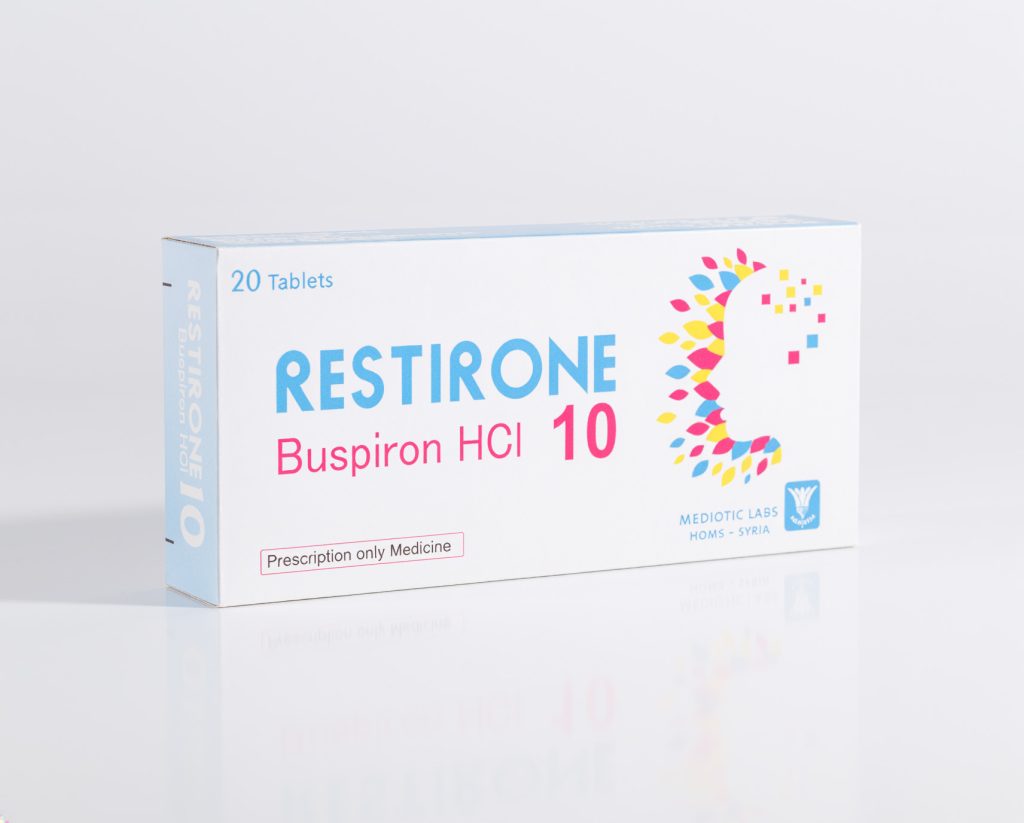
RESTERON 10
Composition : Buspirone hcl 10 mg
Pharmaceutical Forms : Tablets
Usage : Anti-anxiety
Mechanism of action:
The mechanism of action of buspirone is unknown. Buspirone differs from typical benzodiazepine anxiolytics in that it does not exert anticonvulsant or muscle relaxant effects.
In vitro preclinical studies have shown that buspirone has a high affinity for serotonin (5- HT) receptors. Buspirone has no significant affinity for benzodiazepine receptors and does not affect GABA binding.
Buspirone has moderate affinity for brain D2-dopamine receptors.
Pharmacokinetics:
Buspirone is rapidly absorbed in man and undergoes extensive first-pass metabolism. Following oral administration, plasma concentrations of unchanged buspirone are very low and variable between subjects. Peak plasma levels of 1 to 6 ng/mL have been observed 40 to 90 minutes after single oral doses of 20 mg.
The effects of food upon the bioavailability of buspirone have been studied in eight subjects. Buspirone is metabolized primarily by oxidation, which in vitro has been shown to be mediated by cytochrome P450 3A4 (CYP3A4).
INDICATIONS:
Buspirone hydrochloride tablets are indicated for the management of anxiety disorders or the short-term relief of the symptoms of anxiety. Anxiety or tension associated with the stress of everyday life usually
does not require treatment with an anxiolytic.
The efficacy of buspirone has been demonstrated in controlled clinical trials of outpatients whose diagnosis roughly corresponds to Generalized Anxiety Disorder (GAD).
CONTRAINDICATIONS:
Buspirone tablets are contraindicated in patients hypersensitive to buspirone
hydrochloride.
WARNINGS:
The administration of buspirone to a patient taking a monoamine oxidase inhibitor (MAOI) may pose a hazard. There have been reports of the occurrence of elevated blood pressure when buspirone has been added to a regimen including an MAOI. Therefore, it is recommended that buspirone not be used concomitantly with an MAOI. Because buspirone has no established antipsychotic activity, it should not be employed in lieu of appropriate antipsychotic treatment.
PRECAUTIONS:
General:
Interference with Cognitive and Motor Performance:
Studies indicate that buspirone is less sedating than other anxiolytics and that it does not produce significant functional impairment. However, its CNS effects in any individual patient may not be predictable. Therefore, patients should be cautioned about operating an automobile or using complex machinery until they are reasonably certain that buspirone treatment does not affect them adversely.
Potential for Withdrawal Reactions in Sedative/Hypnotic/Anxiolytic Drug-Dependent Patients Because buspirone does not exhibit cross-tolerance with benzodiazepines and other common sedative/hypnotic drugs, it will not block the withdrawal syndrome often seen with cessation of therapy with these drugs.
Therefore, before starting therapy with buspirone, it is advisable to withdraw patients gradually, especially patients who have been using a CNS-depressant drug chronically, from their prior treatment.
Rebound or withdrawal symptoms may occur over varying time periods, depending in part on the type of drug, and its effective half-life of elimination.
The syndrome of withdrawal from sedative/hypnotic/anxiolytic drugs can appear as any combination of irritability, anxiety, agitation, insomnia, tremor, abdominal cramps, muscle cramps, vomiting, sweating, flu-like symptoms without fever, and occasionally even as seizures.
Clinical experience in controlled trials has failed to identify any significant neuroleptic-like activity; however, a syndrome of restlessness, appearing shortly after initiation of treatment, has been reported in some small fraction of buspirone-treated patients. The syndrome may be explained in several ways. For example, buspirone may increase central noradrenergic activity; alternatively, the effect may be attributable to dopaminergic effects (i.e., represent akathisia).
ADVERSE REACTIONS:
Commonly Observed:
The more commonly observed untoward events associated with the use of buspirone not seen at an equivalent incidence among placebo-treated patients include dizziness, nausea, headache, nervousness, lightheadedness, and excitement.
Associated With Discontinuation of Treatment:
The more common events causing discontinuation included: central nervous system disturbances (3.4%), primarily dizziness, insomnia, nervousness, drowsiness, and lightheaded feeling; gastrointestinal disturbances (1.2%), primarily nausea; and miscellaneous disturbances (1.1%), primarily headache and fatigue. In addition, 3.4% of patients had multiple complaints, none of which could be characterized as primary. Cardiovascular Frequent was nonspecific chest pain; infrequent were syncope, hypotension, and hypertension.
Central Nervous System Frequent were dream disturbances; infrequent were depersonalization, dysphoria, noise intolerance, euphoria, akathisia, fearfulness, loss of
interest, dissociative reaction, hallucinations, involuntary movements, slowed reaction time, suicidal ideation, and seizures.
Frequent were tinnitus, sore throat, and nasal congestion; infrequent were redness and itching of the eyes, altered taste, altered smell, and conjunctivitis.
Gastrointestinal Infrequent were flatulence, anorexia, increased appetite, salivation, irritable colon, and rectal bleeding; rare was burning of the tongue.
Genitourinary Infrequent were urinary frequency, urinary hesitancy, menstrual irregularity and spotting, and dysuria.
Musculoskeletal Infrequent were muscle cramps, muscle spasms, rigid/stiff muscles, and arthralgias;
Respiratory Infrequent were hyperventilation, shortness of breath, and chest congestion. Sexual Function Infrequent were decreased or increased libido.
Skin Infrequent were edema, pruritus, flushing, easy bruising, hair loss, dry skin, facial edema, and blisters.
Clinical Laboratory Infrequent were increases in hepatic aminotransferases (SGOT, SGPT.
Miscellaneous Infrequent were weight gain, fever, roaring sensation in the head, weight loss, and malaise.
OVERDOSAGE Signs and Symptoms:
In clinical pharmacology trials, doses as high as 375 mg/day were administered to healthy male volunteers. As this dose was approached, the following symptoms were observed: nausea, vomiting, dizziness, drowsiness, miosis, and gastric distress. A few cases of overdosage have been reported, with complete recovery as the usual outcome. No deaths have been reported following overdosage with buspirone alone. Rare cases of intentional overdosage with a fatal outcome were invariably associated with ingestion of multiple drugs and/or alcohol, and a casual relationship of buspirone could not be determined.
Recommended Overdose Treatment:
General symptomatic and supportive measures should be used along with immediate gastric lavage.
Respiration, pulse, and blood pressure should be monitored as in all cases of drug
overdosage. No specific antidote is known to buspirone, and dialyzability of buspirone has not been determined.
Drug Interactions
MAO inhibitors:
It is recommended that buspirone hydrochloride tablets not be used concomitantly with MAO inhibitors.
Amitriptyline:
After addition of buspirone to the amitriptyline dose regimen, no statistically significant differences in
the steady-state pharmacokinetic parameters (C, AUC, and Cmax) of amitriptyline or its metabolite
nortriptyline were observed.
Diazepam:
After addition of buspirone to the diazepam dose regimen, no statistically significant differences in the
steady-state pharmacokinetic parameters (C, AUC, and C) were observed for diazepam,
but increases of about 15% were seen for nordiazepam, and minor adverse clinical effects (dizziness,
headache, and nausea) were observed.
Haloperidol:
In a study in normal volunteers, concomitant administration of buspirone and haloperidol resulted in increased serum haloperidol concentrations. The clinical significance of this finding is not clear.
Trazodone:
There is one report suggesting that the concomitant use of trazodone hydrochloride and buspirone may
have caused 3 to 6 fold elevations on SGPT (ALT) in a few patients.
Triazolam/flurazepam:
Coadministration of buspirone with either triazolam or flurazepam did not appear to prolong or intensify
the sedative effects of either benzodiazepine.
Other psychotropics:
Because the effects of concomitant administration of buspirone with most other psychotropic drugs
have not been studied, the concomitant use of buspirone with other CNS-active drugs should be approached with caution.
Inhibitors and Inducers of Cytochrome P450 3A4 (CYP3A4):
Buspirone has been shown in vitro to be metabolized by CYP3A4. This finding is consistent with the in vivo interactions observed between buspirone and the following: Diltiazem and verapamil:
coadministration of buspirone (10 mg as a single dose) with verapamil (80 mg t.i.d.) or diltiazem (60 mg t.i.d.) increased plasma buspirone concentrations (verapamil increased AUC and C of buspirone 3.4 fold while diltiazem increased AUC and C 5.5 fold and 4 fold, respectively). Adverse events attributable to buspirone may be more likely during concomitant administration with either diltiazem or verapamil. Subsequent dose adjustment may be necessary and should be based on clinical assessment. Erythromycin:
coadministration of buspirone (10 mg as a single dose) with erythromycin (1.5 g/day for 4 days) increased plasma uspirone concentrations (5 fold increase in C and 6 fold increase in AUC). These pharmacokinetic interactions were accompanied by an increased incidence of side effects attributable to buspirone. If the two drugs are to be used in combination, a low dose of buspirone (e.g., 2.5 mg b.i.d.) is recommended. Subsequent dose adjustment of either drug should be based on clinical assessment.
Grapefruit juice:
coadministration of buspirone (10 mg as a single dose) with grapefruit
juice (200 mL double-strength t.i.d. for 2 days) increased plasma buspirone concentrations (4.3 fold increase in C ; 9.2 fold increase in AUC). Patients receiving buspirone should be advised to avoid drinking such large amounts of grapefruit juice. Itraconazole:
coadministration of buspirone (10 mg as a single dose) with
itraconazole (200 mg/day for 4 days) increased plasma buspirone concentrations (13 fold increase in C and 19 fold increase in AUC). These pharmacokinetic interactions were accompanied by an increased incidence of side effects attributable to buspirone. If the two drugs are to be used in combination, a low dose of buspirone (e.g., 2.5 mg q.d.) is recommended. Subsequent dose adjustment of either drug should be based on clinical assessment.
Nefazodone:
coadministration of buspirone (2.5 or 5 mg b.i.d.) with nefazodone (250 mg b.i.d.) resulted in marked increases in plasma buspirone concentrations (increases up to 20 fold in C and up to 50 fold in AUC) and statistically significant decreases (about 50%) in plasma concentrations of the buspirone metabolite.
Rifampin:
coadministration of buspirone (30 mg as a single dose) with rifampin
(600 mg/day for 5 days) decreased the plasma concentrations (83.7% decrease in C ; 89.6% decrease in AUC) and pharmacodynamic effects of buspirone. If the two drugs are to be used in combination, the dosage of buspirone may need adjusting to maintain anxiolytic effect.
Other inhibitors and inducers of CYP3A4:
Substances that inhibit CYP3A4, such as ketoconazole or ritonavir, may inhibit buspirone metabolism and increase plasma concentrations of buspirone while substances that induce CYP3A4, such as dexamethasone or certain anticonvulsants (phenytoin, phenobarbital, carbamazepine), may increase the rate of buspirone metabolism. If a patient has been titrated to a stable dosage on buspirone, a dose increased AUC and C of buspirone 3.4 fold while diltiazem increased AUC and C 5.5 fold and 4 fold,
respectively.
Cimetidine:
Coadministration of buspirone with cimetidine was found to increase C (40%) and T (2 fold), but had minimal effects on the AUC of buspirone.
Protein Binding:
In vitro, buspirone does not displace tightly bound drugs like phenytoin, propranolol, and warfarin from serum proteins. However, there has been one report of prolonged prothrombin time when buspirone was added to the regimen of a patient treated with warfarin. The patient was also chronically receiving phenytoin, phenobarbital, digoxin, and levothyroxine sodium. In vitro, buspirone may displace less firmly bound drugs like digoxin. The clinical significance of this property is unknown.
Therapeutic levels of aspirin, desipramine, diazepam, flurazepam, ibuprofen, propranolol, thioridazine, and tolbutamide had only a limited effect on the extent of binding of buspirone to plasma proteins.
Pregnancy:Pregnancy Category B
adequate and well-controlled studies during pregnancy have not been performed.
Because animal reproduction studies are not always predictive of human response, this drug should be used during pregnancy only if clearly needed.
Nursing Mothers:
The extent of the excretion in human milk of buspirone or its metabolites is not known. Buspirone hydrochloride tablets administration to nursing women should be avoided if clinically possible.
Use in Patients With Impaired Hepatic or Renal Function:
Buspirone is metabolized by the liver and excreted by the kidneys. A pharmacokinetic study in patients with impaired hepatic or renal function demonstrated increased plasma levels and a lengthened half-life
of buspirone. Therefore the administration of buspirone hydrochloride tablets to patients with severe hepatic or renal impairment cannot be recommended. DOSAGE AND ADMINISTRATION:
The recommended initial dose is 15 mg daily (7.5 mg b.i.d.). To achieve an optimal therapeutic response, at intervals of 2 to 3 days the dosage may be increased 5 mg per day, as needed. The maximum daily dosage should not exceed 60 mg per day. In clinical trials allowing dose titration, divided doses of 20 to 30 mg per day were commonly employed.
The bioavailability of buspirone is increased when given with food as compared to the fasted state.
Consequently, patients should take buspirone in a consistent manner with regard to the timing of dosing; either always with or always without food.
When buspirone is to be given with a potent inhibitor of CYP3A4 the dosage
recommendations described in the Drug Interactions section should be followed. Packaging:2 blisters in carton box, each one contains (10) tablets.
Storage conditions:store at room temperature, between(20-25)°C, away from moisture and light.
Related Products.
- New
PHENOBARBITALMediotec 15

- New
PREVERSIL EXTRA 10/5/2.5

- New
Xarivan 20

- New
ASMNOL 2.5

- New
BELORAMINE

- New