

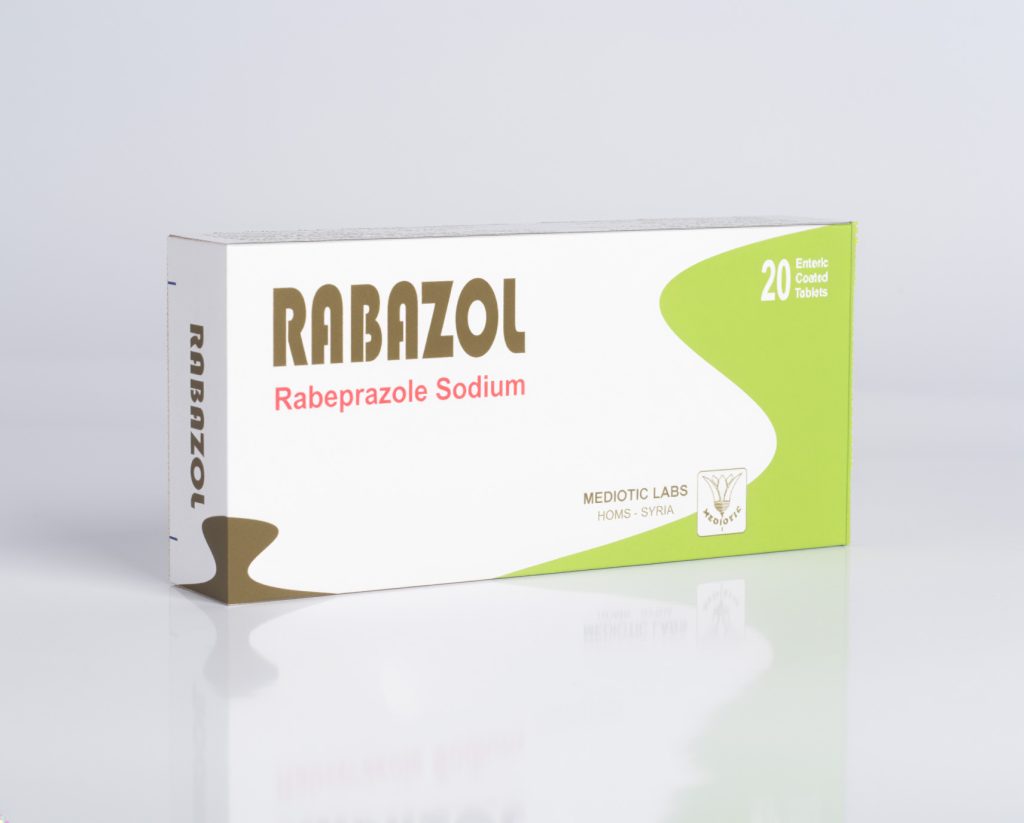
RABAZOL
Composition : Raberazole Sodium 20 mg
Pharmaceutical Forms : Tablets
Usage : Treatment of Peptic ulcer
Each delayed release enteric-coated tablet contains: 20 mg rabeprazole sodium. Properties:
Rabeprazole sodium belongs to the class of anti-secretory compounds the substituted benzimidazoles that suppress gastric acid secretion by the specific inhibition of the H/K- ATPase enzyme (the acid-proton-pump). After oral administration of a 20 mg dose of rabeprazole sodium the onset of anti-secretory occurs within one hour, with the maximum effect occurring within 2-4 hours, and the duration of inhibition lasting up to 48 hours. The inhibitory effect of rabeprazole sodium on acid secretion increases slightly with repeated once-daily dosing, achieving steady state inhibition after three days. When the drug is discontinued, secretory activity normalizes over 2-3 days. Pharmacokinetic properties:
Rabazole absorption is rapid, with peak plasma concentrations occurring approximately 3.5 hours after a 20 mg dose.
Absolute bioavailability is about 52% due in large part to pre-systemic metabolism. Rabazole is approximately 97% bound to human plasma protein. It is metabolized by isoenzymes of CYP 450. Approximately 90% of the dose is eliminated in urine as
metabolites (mercapturic acid conjugate and carboxylic acid). The remainder of the dose was recovered in feces.
Elderly:
Elimination of Rabeprazole was decreased in the elderly.
Hepatic dysfunction:
Following a single 20 mg dose of Rabeprazole to patients with chronic mild to moderate hepatic impairment the AUC doubled and there was a 2-3 fold increase in half-life of Rabeprazole compared to the healthy volunteers.
Renal dysfunction:
In patients with renal disease requiring maintenance hemodialysis, no clinically significant difference observed in the pharmacokinetics of rabeprazol after a single 20 mg oral dose when compared to healthy volunteers.
Indications:
Rabazol is indicated for the treatment of:
- Active duodenal ulcer.
- Active benign gastric ulcer.
- Treatment of ulcerative or erosive gastroesophageal reflux disease.
- Long term treatment of symptomatic erosive or ulcerative gastroesophageal reflux disease (GERD).
- Pathological hypersecretory conditions including Zollinger-Ellison syndrome. Contraindications:
RABAZOL is contra – indicated in:
Patients with hypersensitivity to rabeprazole sodium or to any excipient used in the formulation.
Pregnancy and during breast-feeding.
Children.
Side Effects:
RABAZOL tablets were generally well tolerated, but the observed side effects have generally been mild to moderate and transient in nature.
The most common adverse effects are: headache, diarrhea, and nausea: other adverse effects: rhinitis, abdominal pain, asthenia, flatulence, dry mouth and rash
Precautions:
The possibility of malignancy should be excluded prior to treatment to RABAZOL
care should be taken when treatment with rabeprazole is first initiated in patients with severe hepatic dysfunction.
Drug Interactions:
Studies in healthy subjects have shown that RABAZOL does not have clinically
significant interactions with other drugs studied including warfarin, phenytoin, theophilline,
or diazepam metabolized by the CYP 450 system.
Co-administration of Rabazol sodium results in a 33% decrease in ketoconazole levels and a 22% increase in trough digoxin levels in normal subjects.
Therefore individual patients may need to be monitored to determine if a dosage
adjustment is necessary when such drugs are taken concomitantly with rabeprazole. No clinically relevant interaction with food.
Dosage and Administration:
Active duodenal ulcer and active benign gastric ulcer:
The recommended oral dose for both is 20 mg to be taken once daily in the morning. Some patients with active duodenal ulcer may respond to one 10 mg tablet to be taker once daily in the morning.
Most patients with active duodenal ulcer heal within 2-4 weeks. A few patients may require an additional 4 weeks of therapy to achieve healing.
Most patients with active benigin gastric ulcer heal within six weeks.
A few patients may need an additional six weeks of therapy to achieve healing.
Ulcerative gastroesophageal reflux disease:
The recommended dose is 20 mg to be taken once daily for 4 – 8 weeks. Maintenance of healing of gastroesophageal reflux disease:
20 mg once daily.
Pathological hypersecretory conditions including Zollinger – Ellison syndrome: 60 mg once daily, some patients need divided doses.
storage:
– Protect from light and moistur.
-Store at room temperature, between(15-30)°C
Packaging:
2 blisters,each one contains 10 delayed release, enteric coated tablets / carton box.
Related Products.
- New
BROMHEXINE
- New
PREVERSIL 8
- New
ABILY 30
- New
PREVERSIL PLUS8/5
- New
ASMNOL 2.5
- New