

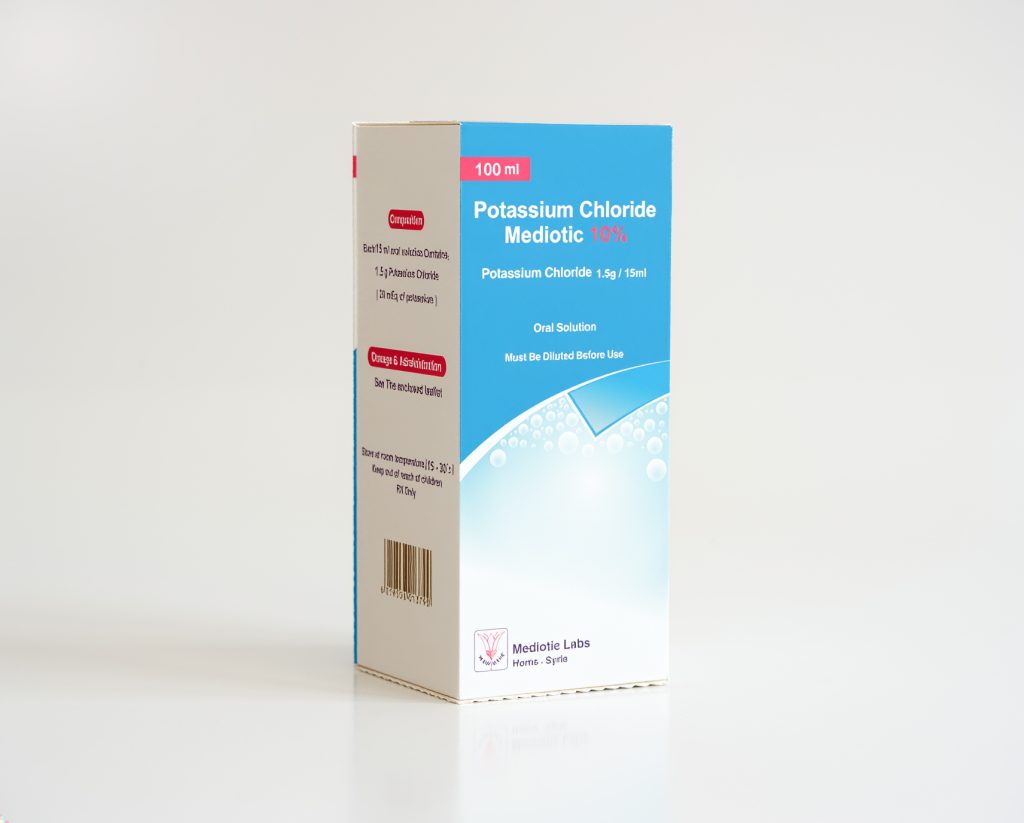
POTASSIUM CHLORIDE MEDIOTIC
Composition : Potassium chloride 1.5 g/15 ml
Pharmaceutical Forms : Syrup & Oral Suspension
Usage : Mineral electrolytes for dehydration and renal disorders
Composition:
Potassium Chloride Mediotic 10% Oral Solution: Each 15 ml (tablespoonful) contains: 20 mEq of potassium (1.5 g of potassium chloride), in a palatable, orange flavored, sugar free, alcohol free vehicle.
Excipients: Citric acid anhydrous, Glycerin, Methylparaben, Natural/artificial orange flavor, Propylene glycol, Propylparaben, Purified water, Sodium citrate dihydrate, Sucralose, Sunset yellow.
Mechanism of Action and Pharmacodynamics: Potassium Chloride Mediotic oral solution 10% and Extended Release Tablets are electrolyte replenishers.
The potassium ion (K+) is the principal intracellular cation of most body tissues. Potassium ions participate in a number of essential physiological processes including the maintenance of intracellular tonicity; the transmission of nerve impulses; the contraction of cardiac, skeletal, and smooth muscle; and the maintenance of normal renal function.
The intracellular concentration of potassium is approximately 150 to 160 mEq per liter. The normal adult plasma concentration is 3.5 to 5 mEq per liter. An active ion transport system maintains this gradient across the plasma membrane.
Potassium is a normal dietary constituent, and under steady-state conditions the amount of potassium absorbed from the gastrointestinal tract is equal to the amount excreted in the urine. The usual dietary intake of potassium is 50 to 100 mEq per day.
Pharmacokinetics: The potassium chloride in extended-release tablets is completely absorbed before it leaves the small intestine. The wax matrix is not absorbed and is excreted in the feces; in some instances the empty matrices may be noticeable in the stool. When the bioavailabilty of the potassium ion from the potassium chloride extended-release tablets is compared to that of a true solution the extent of absorption is similar. The extended-release properties of potassium chloride extended-release tablets are demonstrated by the finding that a significant increase in time is required for renal excretion of the first 50% of the potassium chloride extended-release tablets dose as compared to the solution. Increased urinary potassium excretion is first observed 1 hour after administration of potassium chloride extended-release tablets, reaches a peak at approximately 4 hours, and extends up to 8 hours. Mean daily steady-state plasma levels of potassium following daily administration of potassium chloride extended-release tablets cannot be distinguished from those following administration of potassium chloride solution from control plasma levels of potassium ion.
Based on published literature, the rate of absorption and urinary excretion of potassium from KCI oral solution were higher during the first few hours after dosing relative to modified release KCI products. The bioavailability of potassium, as measured by the cumulative urinary excretion of K+ over a 24 hour post dose period, is similar for KCI solution and modified release products.
Indications:
- For the treatment of patients with hypokalemia, with or without metabolic alkalosis; in digitalis intoxication; and in patients with hypokalemic familial periodic paralysis. If hypokalemia is the result of diuretic therapy, consideration should be given to the use of a lower dose of diuretic, which may be sufficient without leading to hypokalemia.
- For the prevention of hypokalemia in patients who would be at particular risk if hypokalemia were to develop, e.g., digitalized patients or patients with significant cardiac arrhythmias.
The use of potassium salts in patients receiving diuretics for uncomplicated essential hypertension is often unnecessary when such patients have a normal dietary pattern and when low doses of the diuretic are used. Serum potassium should be checked periodically, however, and if hypokalemia occurs, dietary supplementation with potassium-containing foods may be adequate to control milder cases. In more severe cases, and if dose adjustment of the diuretic is ineffective or unwarranted, supplementation with potassium salts may be indicated. Contraindications: Potassium supplements are contraindicated in patients with hyperkalemia since further increase in serum potassium concentration in such patients can produce cardiac arrest. Hyperkalemia may complicate any of the following conditions: chronic renal failure, systemic acidosis such as diabetic acidosis, acute dehydration, extensive tissue breakdown as in severe burns, adrenal insufficiency, or the administration of a potassium-sparing diuretic (e.g., spironolactone, triamterene, amiloride).
Extended-release formulations of potassium chloride have produced esophageal ulceration in certain cardiac patients with esophageal compression due to an enlarged left atrium. Potassium supplementation, when indicated in such patients, should be given as a liquid preparation. All solid oral dosage forms of potassium chloride are contraindicated in any patient in whom there is structural, pathological (e.g., diabetic gastroparesis) or pharmacologic (use of anticholinergic agents or other agents with anticholinergic properties at sufficient doses to exert anticholinergic effects) cause for arrest or delay in tablet passage through the gastrointestinal tract.
Side Effects: One of the most severe adverse effects is hyperkalemia. There also have been reports of upper and lower gastrointestinal conditions including obstruction, bleeding, ulceration and perforation.
The most common adverse reactions to the potassium salts are nausea, vomiting, flatulence, abdominal pain/discomfort and diarrhea. These symptoms are due to irritation to the gastrointestinal tract and are best managed by diluting the preparation further, taking the dose with meals, or reducing the amount taken at one time.
Warnings & Precautions: POTASSIUM CHLORIDE ORAL SOLUTION 10% LIQUIDS WILL CAUSE GASTROINTESTINAL IRRITATION IF ADMINISTERED UNDILUTED.
Increased dilution of the solution and taking with meals may reduce gastrointestinal irritation.
Drug & Food Interactions:
Potassium-sparing diuretic: Use with potassium-sparing diuretic can produce severe hyperkalemia. Avoid concomitant use.
Angiotensin converting enzyme inhibitors: Use with angiotensin converting enzyme (ACE) inhibitors produces potassium retention by inhibiting aldosterone production. Potassium supplements should be given to patients receiving ACE inhibitors only with close monitoring.
Angiotensin Receptor Blockers: Use with angiotensin receptor blockers (ARBs) produces potassium retention by inhibiting aldosterone production. Potassium supplements should be given to patients receiving ARBS only with close monitoring.
Use in Special Populations:
Pregnancy Category C: It is unlikely that potassium supplementation that does not lead to hyperkalemia would have an adverse effect on the fetus or would affect reproductive capacity.
Nursing Mothers: The normal potassium ion content of human milk is about 13 mEq per liter. Since oral potassium becomes part of the body potassium pool, so long as body potassium is not excessive, the contribution of potassium chloride supplementation should have little or no effect on the level in human milk.
Pediatric Use: The safety and effectiveness of potassium chloride have been demonstrated in children with diarrhea and malnutrition from birth to 16 years.
Geriatric Use: Clinical studies of potassium chloride did not include sufficient numbers of subjects aged 65 and over to determine whether they respond differently from younger subjects. Other reported clinical experience has not identified differences in responses between the elderly and younger patients. In general, dose selection for an elderly patient should be cautious, usually starting at the low end of the dosing range, reflecting the greater frequency of decreased hepatic, renal, or cardiac function, and of concomitant disease or other drug therapy.
clinical status of the patient. Correct volume status, acid-base balance and electrolyte deficits as appropriate. Administration:
If hypokalemia is the result of diuretic therapy, consideration should be given to the use of a lower dose of diuretic, which may be sufficient without leading to hypokalemia.
The usual dietary potassium intake by the average adult is 50 to 100 mEq per day. Potassium depletion sufficient to cause hypokalemia usually requires the loss of 200 mEq or more of potassium from the total body store.
Dosage must be adjusted to the individual needs of each patient. The dose for the prevention of hypokalemia is typically in the range of 20 mEq per day. Doses of 40-100 mEq per day or more are used for the treatment of potassium depletion. Dosage should be divided if more than 20 mEq per day is given such that no more than 20 mEq is given in a single dose.
Potassium chloride extended-release tablets should be taken with meals and with a glass of water or other liquid. This product should not be taken on an empty stomach because of its potential for gastric irritation.
NOTE: Potassium chloride extended-release tablets must be swallowed whole and never crushed, chewed or sucked.
BECAUSE OF REPORTS OF INTESTINAL AND GASTRIC ULCERATION AND BLEEDING WITH EXTENDED-RELEASE POTASSIUM CHLORIDE PREPARATIONS, THESE DRUGS SHOULD BE RESERVED FOR THOSE PATIENTS WHO CANNOT TOLERATE OR REFUSE TO TAKE LIQUID OR EFFERVESCENT POTASSIUM PREPARATIONS OR FOR PATIENTS IN WHOM THERE IS A PROBLEM OF COMPLIANCE WITH THESE PREPARATIONS.
Dilute the potassium chloride solution with at least 4 ounces (118.294 ml of cold water).
If serum potassium concentration is less than 2.5 mEq/L, use intravenous potassium instead of oral supplementation. Adult Dosing
Treatment of Hypokalemia:
Daily dose range from 40 to 100 mEq. Give in 2 to 5 divided doses: limit doses to 40 mEq per dose. The total daily dose should not exceed 200 mEq in a 24 hour period.
Maintenance or Prophylaxis:
Typical dose is 20 mEq per day. Individualize dose based upon serum potassium levels.
Studies support the use of potassium replacement in digitalis toxicity. When alkalosis is present, normokalemia and hyperkalemia may obscure a total potassium deficit. The advisability of use of potassium replacement in the setting of hyperkalemia is uncertain. Pediatric Dosing
Treatment of Hypokalemia:
Pediatric patients aged birth to 16 years old: The initial dose is 2 to 4 mEq/kg/day in divided doses; do not exceed as a single dose 1 mEq/kg or 40 mEq, whichever is lower; maximum daily doses should not exceed 100 mEq. If deficits are severe or ongoing losses are great, consider intravenous therapy.
Maintenance or Prophylaxis:
Pediatric patients aged birth to 16 years old: Typical dose is 1 mEq/kg/day. Do not exceed 3 mEq/kg/day.
Overdosage (Symptoms & Treatment): It is important to recognize that hyperkalemia is usually asymptomatic and may be manifested only by an increased serum potassium concentration (6.5-8.0 mEq/L) and characteristic electrocardiographic changes (peaking of T-waves, loss of P- wave, depression of S-T segment, and prolongation of the QT interval). Late manifestations include paralysis and cardiovascular collapse from cardiac arrest (9-12 mEq/L).
Treatment measures for hyperkalemia include the following:
- Elimination of foods and medications containing potassium and of any agents with potassium-sparing properties.
- Intravenous administration of 300 to 500 ml/hr of 10% dextrose solution containing 10-20 units of crystalline insulin per 1,000 ml.
- Correction of acidosis, if present, with intravenous sodium bicarbonate.
- Use of exchange resins, hemodialysis, or peritoneal dialysis.
In treating hyperkalemia, it should be recalled that in patients who have been stabilized on digitalis, too rapid a lowering of the serum potassium concentration can produce digitalis toxicity.
Packaging:
Glass bottle of 100 ml / carton box with measuring plastic cup.
Storage Conditions: “Keep out of reach of children”
“Store at room temperature, between 15° – 30° C”
Related Products.
- New
BELORAMINE
- New
GRIPPADOL
- New
CYCLOHERP 200
- New
Phenobarbital Mediotic
- New
PIRACETAM Mediotec
- New