

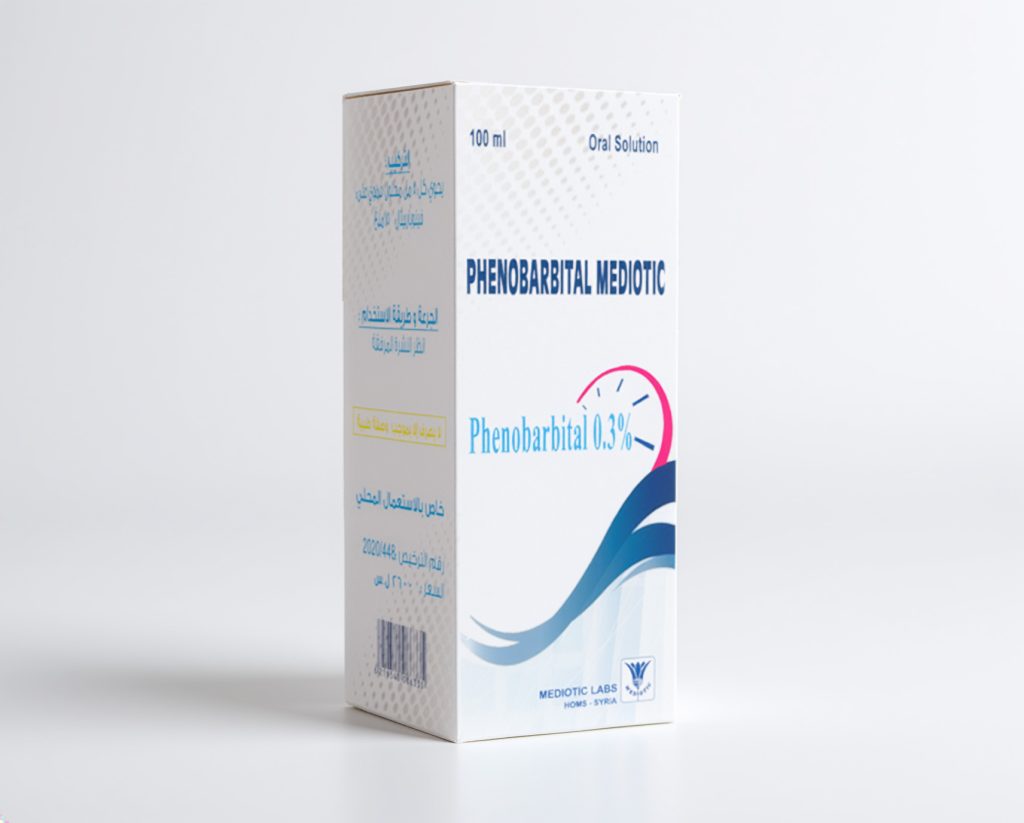
Phenobarbital Mediotic
Composition : Phenobarbital 15 mg / 5ml
Pharmaceutical Forms : Syrup & Oral Suspension
Usage : Anticonvulsant
Phenobarbital Mediotic (TABLETS) (Phenobarbital 15,30,60,100 mg)
Composition: Each tablet contains 15 mg, 30 mg, 60 mg and 100 mg of phenobarbital Excipients: Magnesium stearate – Aerosil – Starch – Microcrystalline cellulose (MCC) – Lactose – Pink colorant(30mg) – Green colorant(60mg) – Blue colorant(100mg).
Mechanism of Action: Phenobarbital, a long-acting barbiturate, is a central nervous system depressant in ordinary doses, the drug acts as a sedative and anticonvulsant.
Pharmacokinetics: Its onset of action occurs in 30 minutes, and the duration of action ranges from 5 to 6 hours. It is detoxified in the liver.
Indications: Phenobarbital Mediotic is indicated for use as a sedative or anticonvulsant Contraindications: Phenobarbital Mediotic is contraindicated in patients who are hypersensitive to barbiturates. In such patients, severe hepatic damage can occur from ordinary doses and is usually associated with dermatitis and involvement of parenchymatous organs. personal or familial history of acute intermittent porphyria represents one of the few absolute contraindications to the use of barbiturates. Phenobarbital is also contraindicated in patients with marked impairment of liver function, or respiratory disease in which dyspnea or obstruction is evident. It should not be administered to persons with known previous addiction to the sedative/hypnotic group, since ordinary doses may be ineffectual and may contribute to further addiction.
SIDE EFFECTS:
CNS Depression: Sedation, drowsiness, lethargy, and vertigo. Emotional disturbances and phobias may be accentuated In some persons, barbiturates such as phenobarbital repeatedly produce excitement rather than depression. Like other nonanalgesic hypnotic drugs, barbiturates, such as phenobarbital, when given in the presence of pain, may cause restlessness, excitement, and even delirium. Symptoms may last for days after the drug is discontinued. Respiratory/Circulatory: Respiratory depression, apnea, circulatory collapse.
Allergic: Acquired hypersensitivity to barbiturates consists chiefly in allergic reactions that occur especially in persons who tend to have asthma, urticaria, angioedema, and similar conditions. Hypersensitivity reactions in this category include localized swelling, particularly of the eyelids, cheeks, or lips, and erythematous dermatitis. Rarely, exfoliative dermatitis(e.g., Stevens- Johnson syndrome and toxic epidermal necrolysis) may be caused by phenobarbital and can prove fatal. The skin eruption may be associated with fever, delirium, and marked degenerative changes in the liver and other parenchymatous organs. In a few cases, megaloblastic anemia has been associated with the chronic use of Phenobarbital.
Other: Nausea and vomiting; headache.
Precautions & Warnings:in small doses, the barbiturates may increase the reaction to painful dictions warnings stimuli. Taken by themselves, the barbiturates cannot be relied upon to relieve pain or even to produce sedation or sleep in the presence of severe pain. Barbiturates induce liver microsomal enzyme activity. This accelerates the biotransformation of various drugs and is probably part of the mechanism of the tolerance encountered with barbiturates. Phenobarbital, therefore, should be used with caution in patients with decreased liver function. This drug should also be administered cautiously to patients with a history of drug dependence or abuse. Phenobarbital may decrease the potency of coumarine anticoagulants; therefore, patients receiving such concomitant therapy should have more frequent prothrombin determinations. As with other sedatives and hypnotics, elderly or debilitated patients may react to barbiturates with marked excitement, depression, or confusion. The systemic effects of exogenous hydrocortisone and endogenous hydrocortisone(cortisol) may be diminished by Phenobarbital. Thus this product should be administered with caution to patients with borderline hypo adrenal function, regardless of whether it is of pituitary or of primary adrenal origin.
Phenobarbital may impair the mental and/or physical abilities required for the performance of potentially hazardous tasks, such as driving a car or operating machinery. The patient should be cautioned accordingly.
pregnancy (category B): phenobarbital Mediotic should be used during pregnancy only if clearly needed.
Nursing Mothers: Caution should be exercised when phenobarbital is administered to a nursing woman.
Drug-drug Interactions:
Phenobarbital in combination with alcohol, tranquilizers, and other central nervous system depressants has additive depressant effects, and the patients should be so advised. Patients taking this be warned not to exceed the dosage recommended by their physician. Toxic effects and fatalities have occurred following overdoses of Phenobarbital alone and in combination with other central nervous system depressants. Caution should be exercised in prescribing unnecessarily large amounts of Phenobarbital for patients who have a history of emotional disturbances or suicidal ideation or who have misused alcohol and other CNS drugs. DOSAGE AND ADMINISTRATION:
Oral Sedative Dose:
Adults 30 to 120 mg daily in 2 or 3 divided doses.
Children: 6 mg/kg of body weight daily in 3 divided doses
Oral Hypnotic Dose
Adults 100 to 320 mg.
Oral Anticonvulsant Dose:
Adults: 50 to 100 mg 2 or 3 times daily.
Children: 15 to 50 mg 2 or 3 times daily.
OVERDOSE: The signs and symptoms of barbiturate poisoning are referable especially to the central nervous system and the cardiovascular system. Moderate intoxication resembles alcoholic inebriation. In severe intoxication, the patient is comatose, the level of reflex activity conforming in a general way to the intensity of the central depression. The deep reflexes may persist for some time despite coexistent coma. The pupils may be constricted and react to light, but late in the courage of barbiturate poisoning they may show hypoxic paralytic dilatation. Respiration is affected early. Breathing may be either slow or rapid and shallow. The blood pressure falls. The patient thus develops a typical shock syndrome, with a weak and rapid pulse, cold and clammy skin, and a rise in the hematocrit. Respiratory complications and renal failure are much dreaded and not infrequent concomitant of severe barbiturate poisoning. There is usually hypothermia, sometimes with temperatures as low as 32°C.
Treatment: General management should consist of symptomatic and supportive the including gastric lavage, administration of intravenous fluids, and maintenance of blood pressure, body temperature and adequate respiratory exchange. Dialysis will increase the rate of removal of barbiturates from the body fluids. Antibiotics may be required to control pulmonary complications.
Presentation: 3 Blisters, each contains 10 white tablets of Phenobarbital MEDIOTIC-15 mg 3 Blisters, each contains 10 pink tablets of Phenobarbital MEDIOTIC-30 mg
3 Blisters, cach contains 10 green tablets of Phenobarbital MEDIOTIC-60 mg. 3 Blisters, each contains 10 blue tablets of Phenobarbital MEDIOTIC-100 mg Storage: Store at room temperature, below 30°C.
Keep out of reach of children.
Protect from moisture & light.
Related Products.
- New
POTASSIUM CHLORIDE MEDIOTIC
- New
CYCLOHERP 400
- New
BELORAMINE
- New
ASMANOL
- New
MEFEN
- New