

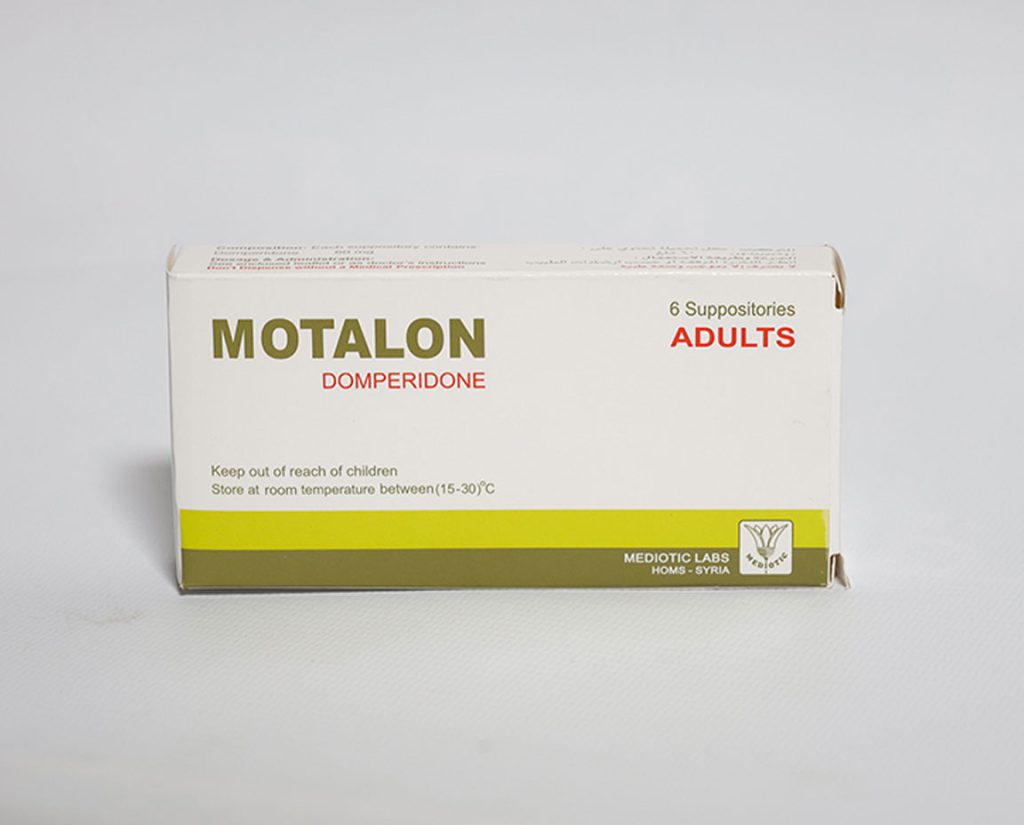
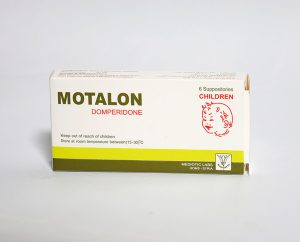
MOTALON 60 mg
Composition : Domperidone 60 mg
Pharmaceutical Forms : Suppositories & Ovules
Usage : Digestive function stimulant
Chemical Composition:
Each Suppository contains: Domperidone 10 mg or 30 mg or 60 mg. Excipients: Hydrogenated vegetable oil, Aerosil.
Pharmacological Classification: Antispasmodic Drugs and Antiemetics.
Pharmacodynamic Effect: Domperidone is a dopamine antagonist with anti-emetic properties. Domperidone does not readily cross the blood-brain barrier. In domperidone users, especially in adults, extrapyramidal disorders are very rare, but domperidone promotes the release of prolactin from the pituitary.
Pharmacokinetics:
Absorption: Based on the Cmax resulting from administering multiple twice daily doses of 60 mg suppository, a 30 mg suppository given twice daily is expected to provide peak plasma levels similar to those of a 10 mg oral dose administered four times a day.
Distribution: Domperidone is 91-93% bound to plasma proteins.
Metabolism: Domperidone undergoes rapid and extensive hepatic metabolism by hydroxylation and N-dealkylation by CYP3A4.
Elimination: Urinary and faecal excretions. The proportion of the drug excreted unchanged is small (10% of faecal excretion and approximately 1% of urinary excretion). The plasma half-life is prolonged in patients with severe renal insufficiency. Indications: Domperidone suppositories is indicated for the relief of the symptoms of nausea and vomiting. Contraindications:
known hypersensitivity to domperidone or any of the excipients.
prolactin-releasing pituitary tumour (prolactinoma).
when stimulation of the gastric motility could be harmful, e.g. in patients with gastro-intestinal haemorrhage, mechanical obstruction or perforation.
In patients with moderate or severe hepatic impairment.
in patients who have known existing prolongation of cardiac conduction intervals, particularly QTc, patients with significant electrolyte disturbances or underlying cardiac diseases such as congestive heart failure.
co-administration with QT-prolonging drugs.
co-administration with potent CYP3A4 inhibitors (regardless of their QT-prolonging effects).
Side Effects:
Common: Dry mouth.
Uncommon: Loss of libido, anxiety, agitation, nervousness, somnolence, headache, extrapyramidal disorder, diarrhoea, rash, pruritus, urticaria, galactorrhoea, breast pain, breast tenderness, and asthenia.
Drug Interactions:
Concomitant use of the following substances is contraindicated:
QTc-prolonging medicinal products (risk of torsades de points).
disopyramide, hydroquinidine, quinidine, amiodarone, dofetilide, dronedarone, ibutilide, sotalol, haloperidol, pimozide, sertindole, citalopram, escitalopram, erythromycin, levofloxacin, moxifloxacin, spiramycin, fluconazole, pentamidine, halofantrine, lumefantrine, cisapride, dolasetron, prucalopride, mequitazine, mizolastine, toremifene, vandetanib, vincamine, bepridil, diphemanil, methadone.
Potent CYP3A4 inhibitors (regardless of their QT-prolonging effects):
ritonavir, saquinaver, telaprevir, itraconazole, ketoconazole, posaconazole, voriconazole, clarithromycin, telithromycin. Concomitant use of the following substances is not recommended:
Moderate CYP3A4 inhibitors i.e., diltiazem, verapamil and some macrolides.
Concomitant use of the following substances requires caution with use:
Caution with bradycardia and hypokalaemia-inducing drugs, as well as with the following macrolides involved in QT interval prolongation: azithromycin and roxithromycin (clarithromycin is contraindicated as it is a potent CYP3A4 inhibitor). The above list of substances is representative and not exhaustive.
Warnings and Precautions:
Renal impairment
Since the elimination half-life of domperidone is prolonged in severe renal impairment, on repeated administration, the dosing frequency of Domperidone should be reduced to once or twice daily depending on the severity of the impairment, and the dose may need to be reduced.
Cardiovascular effects
Domperidone has been associated with prolongation of the QT interval on the electrocardiogram. During post-marketing surveillance, there have been very rare cases of QT-prolongation and torsades de pointes in patients taking domperidone. These reports included patients with confounding risk factors, electrolyte abnormalities and concomitant treatment which may have been contributing factors.
Epidemiological studies showed that domperidone was associated with an increased risk of serious ventricular arrhythmias or sudden cardiac death. A higher risk was observed in patients older than 60 years, patients taking daily doses greater than 30 mg, and patients concurrently taking QT-prolonging drugs or CYP3A4 inhibitors.
Domperidone should be used at the lowest effective dose in adults and children.
Domperidone is contraindicated in patients with known existing prolongation of cardiac conduction intervals, particularly QTc, in patients with significant electrolyte disturbances (hypokalaemia, hyperkalaemia, hypomagnesaemia), or bradycardia, or in patients with underlying cardiac diseases such as congestive heart failure due to increased risk of ventricular arrhythmia.
Electrolyte disturbances (hypokalaemia, hyperkalaemia, hypomagnesaemia) or bradycardia are known to be conditions increasing the proarrythmic risk.
Treatment with domperidone should be stopped if signs or symptoms occur that may be associated with cardiac arrhythmia, and the patients should consult their physician.
Patients should be advised to promptly report any cardiac symptoms.
Paediatric population
Although neurological side effects are rare, the risk of neurological side effects is higher in young children since metabolic functions and the blood-brain barrier are not fully developed in the first months of life. Therefore, it is recommended that the dose be determined accurately and strictly followed in neonates, infants and children.
Overdosing may cause extrapyramidal disorders in children, but other causes should be taken into consideration. Precautions: The suppositories contain butylated hydroxyanisole which can irritate eyes, skin and the lining of the mouth and nose (mucous membranes).
Dosage and Administration:
Domperidone should be used at the lowest effective dose for the shortest duration necessary to control nausea and vomiting. Patients should try to take each dose at the scheduled time. If a scheduled dose is missed, the missed dose should be omitted and the usual dosing schedule resumed. The dose should not be doubled to make up for a missed dose. Usually, the maximum treatment duration should not exceed one week.
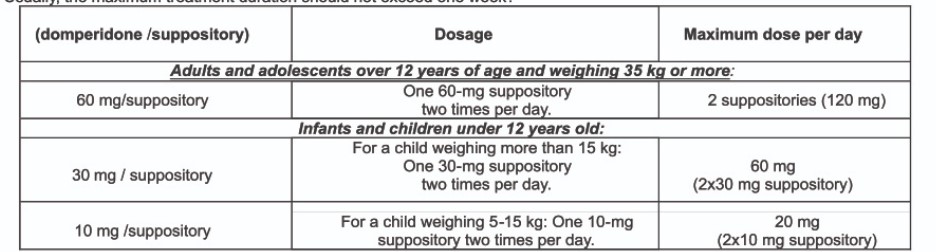
NOTE: Suppositories are unsuitable for use in children weighing less than 5 kg.
Hepatic Impairment Domperidone is contraindicated in moderate or severe hepatic impairment. Dose modification in mild hepatic impairment is however not needed.
Renal Impairment
Since the elimination half-life of domperidone is prolonged in severe renal impairment, on repeated administration, the dosing frequency of Domperidone should be reduced to once or twice daily depending on the severity of the impairment, and the dose may need to be reduced.
Pregnancy and lactation
Pregnancy
There are limited post-marketing data on the use of domperidone in pregnant women. Therefore Domperidone should only be used during pregnancy when justified by the anticipated therapeutic benefit.
Breast-feeding
Domperidone is excreted in human milk and breast-fed infants receive less than 0.1% of the maternal weight-adjusted dose. A decision should be made whether to discontinue breast-feeding or to discontinue/abstain from domperidone therapy taking into account the benefit of breast-feeding for the child and the benefit of therapy for the woman. Caution should be exercised in case of QTc-prolongation risk factors in breast-fed infants.
Overdose:
Symptoms:
Overdose has been reported primarily in infants and children. Symptoms of overdose may include agitation, altered consciousness, convulsion, disorientation, somnolence and extrapyramidal reactions.
Treatment:
There is no specific antidote to domperidone. ECG monitoring should be undertaken. Gastric lavage, as well as the administration of activated charcoal, may be useful. Close medical supervision and supportive therapy is recommended. Anticholinergic, anti-parkinson drugs may be helpful in controlling the extrapyramidal disorders.
Storage conditions: store at room temperature (15-30)°c.
Package:Box contains plastic blisters with 6 suppositories.
Related Products.
- New
MOTALON 10mg
- New
Toplirect Adult

- New
MECOZALEN

- New
MEDIOPAN PLUS ADULT
- New
MOTALON 30mg
- New