

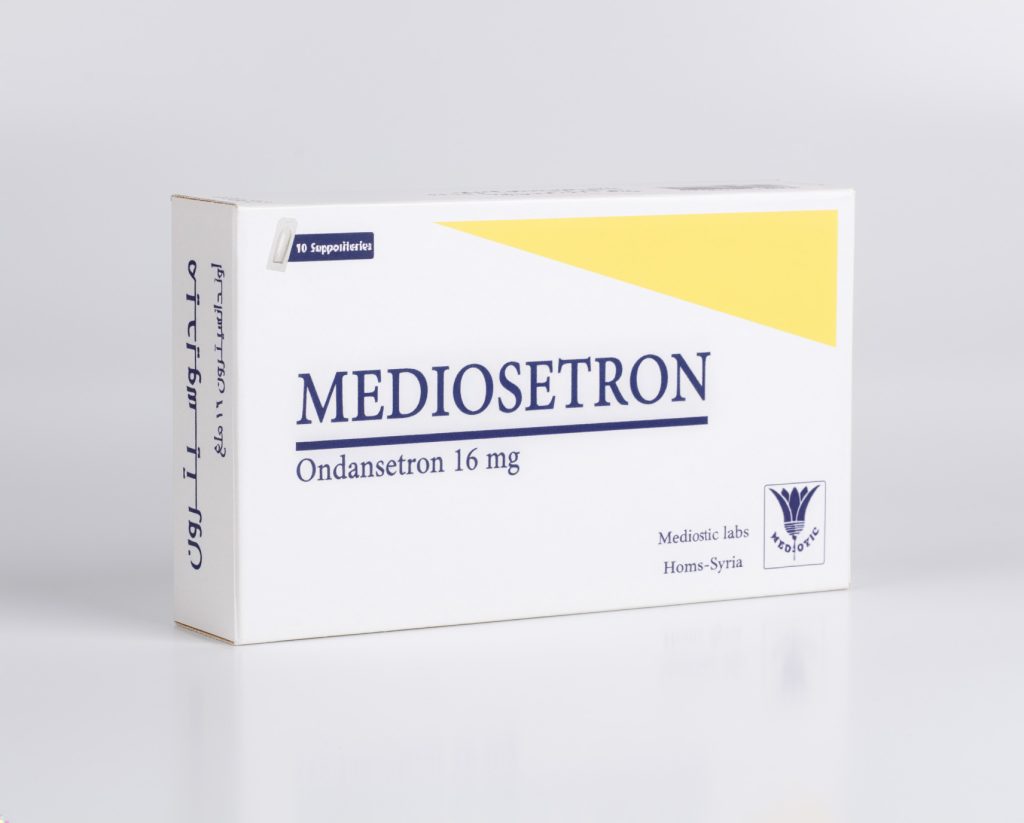
MEDIOSETRON
Composition : Ondansetron 16mg
Pharmaceutical Forms : Suppositories & Ovules
Usage : Antiemetic
(Ondansetron 4 mg, 8 mg)
Ondansetron 4 mg: Each film-coated tablet contains: Ondansetron Hydrochloride Dihydrate equivalent to 4 mg Ondansetron. Ondansetron 8 mg: Each film-coated tablet contains: Ondansetron Hydrochloride Dihydrate equivalent to 8 mg Ondansetron Excipients
Core: Microcrystalline cellulose, Lactose monohydrate, Pregelatinised starch, Magnesium stearte
Film: HPMC, HPC, Titanium dioxide, Vanilin, Sorbic acid, Span 80, Propylene glycol, the strength 4 mg contains red iron oxide Pharmacological properties:
Pharmacodynamic properties:
Ondansetron is a potent, highly selective 5HTs receptor-antagonist. Chemotherapeutic agents and radiotherapy may cause release of 5HT in the small intestine initiating a vomoting reflex by activating vagal afferents via 5HTs receptors. Ondansetron blocks the initiation of this reflex. Thus, the effect of ondansetron in the management of the nausea and vomiting induced by cytotoxic chemotherapy and radiotherapy is probably due to antagonism of 5HT3 receptors on neurons located both in the peripheral and central nervous system..
Ondansetron does not alter plasma prolactin concentrations.
Pharmacokinetic properties:
Following oral administration, ondansetron is passively and completely absorbed from the gastrointestinal tract and undergoes first pass metabolism. Peak plasma concentrations of about 30ng/ml are attained approximately 1.5 hours after an 8mg dose. Bioavailability, following oral administration, is slightly enhanced by the presence of food but unaffected by antacids .Studies in healthy elderly volunteers have shown slight, but clinically insignificant, age-related increases in both oral bioavailability (65%) and half-life (five hours) of ondansetron. Gender differences were shown in the disposition of ondansetron, with females having a greater rate and extent of absorption following an oral dose and reduced systemic clearance and volume of distribution. The terminal half life of about three hours and steady state volume of distribution of about 140L.
Ondansetron is not highly protein bound (70-76%). Ondansetron is cleared from the systemic circulation predominantly by hepatic metabolism through multiple enzymatic pathways. Less than 5% of the absorbed dose is excreted unchanged in the urine.
Therapeutic indications:
Ondansetron is indicated for the prevention of nausea and vomiting associated with:
highly emetogenic cancer chemotherapy, including cisplatin greater than or equal to 50 mg/m2
initial and repeat courses of moderately emetogenic cancer chemotherapy
radiotherapy in patients receiving either total body irradiation, single high-dose fraction to the abdomen, or daily fractions to the abdomen.
Ondansetron is also indicated for the prevention of postoperative nausea and/or vomiting. Contraindications:
Hypersensitivity to any component of the preparation.
Undesirable effects:
Nervous system disorders:
Very common:
Uncommon:
Headache.
Seizures, movement disorders (including extrapyramidal reactions such as dystonic reactions, oculogyric crisis and dyskinesia), observed without definitive evidence of persistent clinical sequelae.
Cardiac disorders: Uncommon:
Vascular disorders:
Common:
Arrhythmias, chest pain with or without ST segment depression, bradycardia.
Sensation of warmth or flushing.
Uncommon:
Hypotension.
Respiratory, thoracic and mediastinal disorders:
Uncommon:
Gastrointestinal disorders:
Common:
Hepatobiliary disorders:
Uncommon:
Special warnings and precautions for use:
Hiccups.
Constipation.
Asymptomatic increases in liver function tests. These events were observed commonly in patients receiving chemotherapy with cisplatin.
Hypersensitivity reactions have been reported in patients who have exhibited hypersensitivity to other selective 5HTs receptor antagonists. Respiratory events should be treated symptomatically and clinicians should pay particular attention to them as precursors of hypersensitivity reactions. Rarely, transient ECG changes including QT interval prolongation have been reported in patients receiving ondansetron. In addition, . Ondansetron should be administered with caution to patients who have or may develop prolongation of QTc. These conditions include patients with electrolyte abnormalities, with congenital long QT syndrome, or patients taking other medicinal products that lead to QT prolongation. Therefore, caution should be exercised in patients with cardiac rhythm or conduction disturbances, in patients treated with antiarrhythmic agents or beta-adrenergic blocking agents and in patients with significant electrolyte disturbances.
As ondansetron is known to increase large bowel transit time, patients with signs of subacute intestinal obstruction should be monitored following administration.
In patients with adenotonsillar surgery prevention of nausea and vomiting with ondansetron may mask occult bleeding. Therefore, such patients should be followed carefully after ondansetron.
Patients with rare hereditary problems of galactose intolerance, the Lapp lactase deficiency or glucose-galactose malabsorption should not take this medicin Interaction with other medicinal products and other forms of interaction:.
Phenytoin, Carbamazepine and Rifampicin: In patients treated with potent inducers of CYP3A4 (i.e. phenytoin, carbamazepine, and rifampicin), the oral clearance of ondansetron was increased and ondansetron blood concentrations were decreased.
Tramadol: ondansetron may reduce the analgesic effect of tramadol.
Use of ondansetron with QT prolonging drugs may result in additional QT prolongation. Concomitant use of ondansetron with cardiotoxic drugs (e.g. anthracyclines) may increase the risk of arrhythmias
Pregnancy:
The use of ondansetron in pregnancy is not recommended.
Based on the Society of Obstetricians and Gynaecologists of Canada guideline on nausea and vomiting of pregnancy and the American College of Obstetricians and Gynecologists practice bulletin, the use of ondansetron may be considered in the treatment of severe or refractory nausea and vomiting when preferred agents have failed. Lactation:
It is recommended that mothers receiving ondansetron should not breast-feed their babies.
Posology and method of administration:
The recommended dosage regimens for adult and pediatric patients are described in Table 1 and Table 2, respectively.
Corresponding doses of ondansetron tablets, ondansetron ODT orally disintegrating tablets and ZOFRAN oral solution may be used interchangeably. Indication Dosage Regimen
Emetogenic
Highly
Cancer
Chemotherapy
Moderately
Emetogenic
Cancer
Chemotherapy
Radiotherapy
Postoperative
A single 24-mg dose administered 30 minutes before the start of single-day highly emetogenic chemotherapy, including cisplatin greater than or equal to 50 mg/m
8 mg administered 30 minutes before the start of chemotherapy, with a subsequent 8- mg dose 8 hours after the first dose.
Then administer 8 mg twice a day (every 12 hours) for 1 to 2 days after completion of chemotherapy.
For total body irradiation: 8 mg administered 1 to 2 hours before each fraction of radiotherapy each day.
For single high-dose fraction radiotherapy to the abdomen: 8 mg administered 1 to 2 hours before radiotherapy, with subsequent 8-mg doses every 8 hours after the first dose for 1 to 2 days after completion of radiotherapy.
For daily fractionated radiotherapy to the abdomen: 8 mg administered 1 to 2 hours before radiotherapy, with subsequent 8-mg doses every 8 hours after the first dosefor each day radiotherapy is given
16 mg administered 1 hour before induction of anesthesia.
Pediatric Recommended Dos age Regimen for Prevention of Nausea and Vomiting:
Indication
Moderately Emetogenic
Cancer Chemotherapy
Dosage in Hepatic Impairment
Dosage Regimen
12 to 17 years of age: 8 mg administered 30 minutes before the start of chemotherapy, with a subsequent 8-mg dose 8 hours after the first dose. Then administer 8 mg twice a day (every 12 hours) for 1 to 2 days after completion of chemotherapy.
4 to 11 years of age: 4 mg administered 30 minutes before the start of chemotherapy, with a subsequent 4-mg dose 4 and 8 hours after the first dose.
Then administer 4 mg three times a day for 1 to 2 days after completion of chemotherapy.
In patients with severe hepatic impairment do not exceed a total daily dose of 8 mg . Administration Instructions for ZOFRAN ODT Orally Disintegrating Tablets
Do not attempt to push ondansetron ODT tablets through the foil backing. With dry hands, PEEL BACK the foil backing of 1 blister and GENTLY remove the tablet. IMMEDIATELY place the ondansetron ODT tablet on top of the tongue where it will dissolve in seconds, then swallow with saliva. Administration with liquid is not necessary.
Overdose:
Symptoms and Signs:
Manifestations that have been reported include visual disturbances, severe constipation, hypotension and a vasovagal episode with transient second degree AV block. Treatment:
There is no specific antidote for ondansetron, therefore in all cases of suspected overdose, symptomatic and supportive therapy should be given as appropriate.
The use of ipecacuanha to treat overdose with ondansetron is not recommended, as patients are unlikely to respond due to the anti-emetic action of ondansetron itself.
Packaging: 3 blisters, each contains 10 film-coated tablets/carton
“Storage Conditions: “Store at room temperature, below 30° C
Related Products.
- New
MECOZALEN-PLUS

- New
PROCTOVASINE
- New
MEDIOPAN PLUS CHIDREN

- New
MECOZALEN
- New
MEDIOPAN PLUS ADULT
- New