

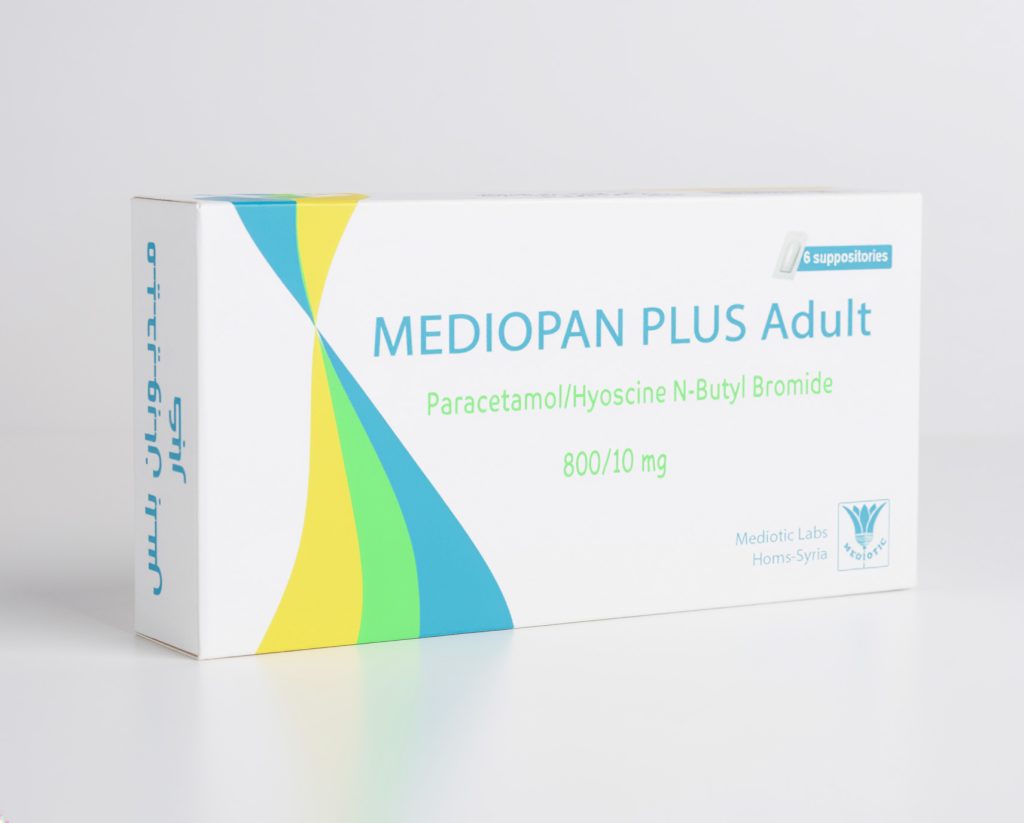
MEDIOPAN PLUS ADULT
Composition : Paracetamol 800mg+Hyoscine Butyl Bromide 10 mg
Pharmaceutical Forms : Suppositories & Ovules
Usage : Analgesic and antispasmodic
10 mg (Hyoscine-N- Butylbromide), 500 mg paracetamol (film-coated tablets) 10 mg (Hyoscine-N- Butylbromide), 800 mg paracetamol (suppositories) 7.5 mg (Hyoscine-N- Butylbromide), 250 mg paracetamol (suppositories)
COMPOSITION & EXCIPIENTS:
Each MEDIOPAN PLUS film-coated tablet contains:
10 mg (Hyoscine-N- Butylbromide), 500 mg Paracetamol.
Each MEDIOPAN PLUS Children suppository (1 g) contains:
7.5 mg Hyoscine Butyl Bromide, 250 mg Paracetamol.
Each MEDIOPAN PLUS Adults suppository (2 g) contains:
10 mg Hyoscine Butyl Bromide, 800 mg Paracetamol. Excipients:
Film coated tablets:
Core: Starch, Magnesium Stearate, Microcrystalline Cellulose.
Film: PEG, Hydroxy Propyl Methyl Cellulose.
Suppositories: Aerosil, Hydrogenated Vegetable Oil.
MECHANISM OF ACTION:
MEDIOTIC
(Hyoscine-N- Butylbromide) acts spasmolytically on the smooth musculature of the gastrointestinal tract, the bile and discharge urinary tract, and the female genital organs. The peripheral anticholinergic effects are due both to the ganglion blockade in the visceral wall and to anti- muscarinic effects.
In addition to a very weak anti-inflammatory effect, paracetamol has analgesic and antipyretic properties. PHARMACOKINETICS PROPERTIES:
(Hyoscine-N- Butylbromide):
Absorption: (Hyoscine-N- Butylbromide) only partly absorbed due to the strong polar properties of this quaternary ammonium compound and the low lipid solubility resulting from after oral (8%) or rectal (3%) administration. Distribution: The plasma protein binding is 4.4%.
Biotransformation and elimination: Butylbromide mainly metabolized by hydrolytic cleavage of the ester bond. Orally applied (Hyoscine-N- Butylbromide) precipitated via faeces and urine. Approximately 90% of the radioactivity was found in the faeces after oral administration; in the urine, up to 5% of the radioactivity was found depending on the type of application. Paracetamol:
Absorption: After oral administration, paracetamol is absorbed rapidly and almost completely in the small intestine. Maximum plasma concentrations are reached 0.5 – 2 hours after administration.
After rectal administration, paracetamol is absorbed with an absolute bioavailability of about 30% to 40%; maximum plasma concentrations are reached after 1.3-3.5 hours.
Distribution: Paracetamol spreads rapidly in all tissues. The plasma protein binding is low (between 5% and 20%).
Biotransformation: Paracetamol is primarily metabolized in the liver.
Elimination: Excretion is predominantly in the urine. The elimination half-life is about two hours.
Renal insufficiency: In severe renal insufficiency (creatinine clearance <10 ml / min) the excretion of paracetamol and its metabolites is delayed.
INDICATIONS:
For patients with convulsive pain in the stomach and intestine disorders, convulsive pain and dysfunction in the area of the bile ducts, the urinary tract and the female genital organs (e.g. dysmenorrhea).
CONTRAINDICATIONS:
- Hypersensitivity to the active substances or to any of the excipients
- Mechanical stenosis of the gastrointestinal tract
- Megacolon
- Urinary retention in subvesical obstruction (e.g. prostate adenoma)
- Angular glaucoma
- Tachycardia and tachyarrhythmia
- Myasthenia gravis
- Severe hepatic insufficiency (Child-Pugh C)
WARNINGS AND PRECAUTIONS:
- A physician should be consulted immediately if severe abdominal pain persists or worsens or occurs together with symptoms such as fever, nausea, vomiting, and changes in intestinal motility, abdominal (pressure) sensitivity, blood pressure drop, fainting, or blood in the stool.
- In order to avoid the risk of overdosing, it should be ensured that concurrent use of other medicinal products does not contain paracetamol.
- This drug should be used with caution in the following cases:
- Hepatocellular insufficiency (Child-Pugh A/B)
- Hepatic dysfunction (e.g. due to chronic alcohol abuse, hepatitis)
- Serious renal insufficiency (creatinine clearance <10 ml / min)
- Gilbert syndrome (Meulengracht disease)
- glucose-6-phosphate dehydrogenase deficiency
- In case of high fever, signs of secondary infection, or persisting symptoms for more than 3 days, the doctor must be consulted.
- The doctor should be consulted if the pain persists or worsens, new symptoms are observed, or redness or swelling occurs, as this may be an indication of serious adverse reactions.
- Blood count, liver and kidney function should be monitored during prolonged use.
- Severe acute hypersensitivity reactions, Such as anaphylactic shock, have been observed very rarely. At the first signs of hypersensitivity reaction, treatment with this drug must be discontinued.
- In the case of prolonged high-dose, inappropriate use of analgesics, headaches may occur which should not be treated by increased doses of the drug.
- Abrupt discontinuation after prolonged high-dose may cause headache, fatigue, muscle pain, nervousness, and vegetative symptoms. The symptom of withdrawal sounds within a few days. Until then, the recovery of painkillers should be omitted, and re-ingestion should not take place without medical advice.
Pregnancy:
There are no adequate data on the use of this drug in pregnant women. It is not known whether (Hyoscine-N- Butylbromide) passes the placenta, so that pharmacological effects on the fetus are possible. Therefore, the use of this drug during pregnancy is therefore not recommended.
Lactation:
It is not known whether (Hyoscine-N- Butylbromide) passes into the mother’s milk. Muscarine receptor antagonists are known to inhibit the production of milk.
The use of this drug during breastfeeding should only be done after a strict indication.
DRUG INTERACTIONS:
- The anticholinergic effects of other anticholinergics, amantadine, tri- and tetracyclic antidepressants, antipsychotics, quinidine, antihistamines, disopyramide, as well as the tachycardia effect of B-sympathomimetics can be enhanced by this drug.
- Concomitant therapy with dopamine antagonists, e.g. metoclopramide, can lead to a mutual attenuation of the effect on the motility of the gastrointestinal tract.
- Concomitant administration of medicinal products which lead to enzyme induction in the liver, (e.g. phenobarbital, phenytoin, carbamazepine) and rifampicin, can cause liver damage with harmless doses of paracetamol. The same applies to potentially hepatotoxic substances as well as to alcohol abuse.
- The use of probenecid leads to a reduction in paracetamol clearance. Taking concurrent use of probenecid, paracetamol doses should be reduced.
- Concomitant use of paracetamol and chloramphenicol may significantly slow the excretion of chloramphenicol and increase its toxicity.
- Concomitant use of paracetamol and zidovudine (AZT or retrovir) increases the tendency to develop neutropenia. This drug should therefore only be administered according to a doctor’s prescription.
- Cholestyramine reduces the effectiveness of paracetamol.
- The simultaneous ingestion of agents that lead to an acceleration of the gastric emptying, For example, metoclopramide, accelerates the uptake and activity of paracetamol.
- In case of simultaneous administration of agents, which lead to a slowing down of the gastric emptying, e.g. propantheline, the uptake and effect of action of paracetamol can be delayed.
- Effects on laboratory values: The paracetamol content of this drug can influence the determination of uric acid by means of phosphorus tungstic acid as well as the glucose oxidase peroxidase glucose determination.
SIDE EFFECTS:
Many of the known undesirable effects are due to the anticholinergic properties of (Hyoscine-N- Butylbromide). These anticholinergic effects are generally mild.
Occasionally: Dizziness, fatigue, Mouth dryness (inhibition of salivary secretion), diarrhea, nausea, vomiting, stomach, airways, chest and mediastinum discomfort.
Rare: Blood pressure drop, erythema, Tachycardia, Micturition disorders such as: Dysuria.
Very rare: Severe skin reactions (such as Stevens-Johnson syndrome (SJS), toxic-epidermal necrolysis (TEN) and acute generalized exanthematous pustulitis (AGEP)) have been reported under paracetamol, Accommodation disorders, especially in patients who are hyperopic and not adequately corrected; Glaucoma.
Posology and method of administration:
- Adults and adolescents from 12 years of age:
- Film coated tablets: 1 – 2 film coated tablets Up to 3 times daily.
- Suppository (10/800): 1 suppository Up to 3-4 times a day.
The maximum dose per day of 6 film coated tablets or 4 suppositories must not be exceeded. The time interval between doses should be at least 6 hours (suppository) or 8 hours (film-coated tablets).
- Children from 6 -12 years old:
Suppository (7.5/250): 1-2 supp daily 3-4 times
The film coated tablets should be swallowed whole with sufficient liquid.
The suppository should be inserted into the empty rectum.
The use of this drug over a period of more than 3 – 4 days is to be weighed by a doctor.
OVERDOSING:
Symptoms:
- (Hyoscine-N- Butylbromide): If overdose, anticholinergic symptoms such as blurred vision, tachycardia, mouth dryness and skin redness are to be expected. Death occurs through breathing paralysis.
- Paracetamol: There is a risk of intoxication, especially in elderly people, small children, persons with liver disease, chronic alcohol abuse, chronic deficiency, and at the same time taking medicines that lead to enzyme induction. In these cases, overdosing can lead to death. Symptoms occur within 24 hours: nausea, vomiting, anorexia, pallor, and abdominal pain. Clinical symptoms of liver injury are usually visible after 2 days and reach a maximum after 4 to 6 days. Even if no severe liver damage is present, acute kidney failure with acute tubule necrosis may occur.
Treatment:
- Already in case of suspicion of intoxication with paracetamol, the intravenous administration, for example, N-acetylcysteine. However, N-acetylcysteine can still provide some protection even after 10 and up to 48 hours. The plasma concentration of paracetamol can be reduced by dialysis. Determination of the plasma concentration of paracetamol is recommended. The further treatment options for the treatment of intoxication with paracetamol depend on the extent, stage and clinical symptoms according to the usual measures in intensive care.
- For pronounced anticholinergic effects ((Hyoscine-N- Butylbromide)), para-sympathomimetics should be used (neostigmine 0.5 – 2.5 mg i.m. or i.v.). In glaucoma patients, pilocarpine is local; an eye doctor should be consulted immediately. Catheterize during urine retention. Cardiovascular complications are to be treated according to the usual therapy principles.
STORAGE CONDITIONS:
Store at room temperature, below 30 °C.
Keep out of reach of children.
PACKAGING:
Film coated tablets: 2 blisters, each contains 10 film coated tablets/carton box.
Suppositories: 1 plastic blister contains 6 suppositories/carton box.
Related Products.
- New
MEDIORAN
- New
KETOPROFEN
- New
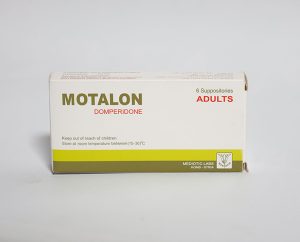
MOTALON 10mg
- New
MECOZALEN
- New
MOTALON 60 mg
- New