

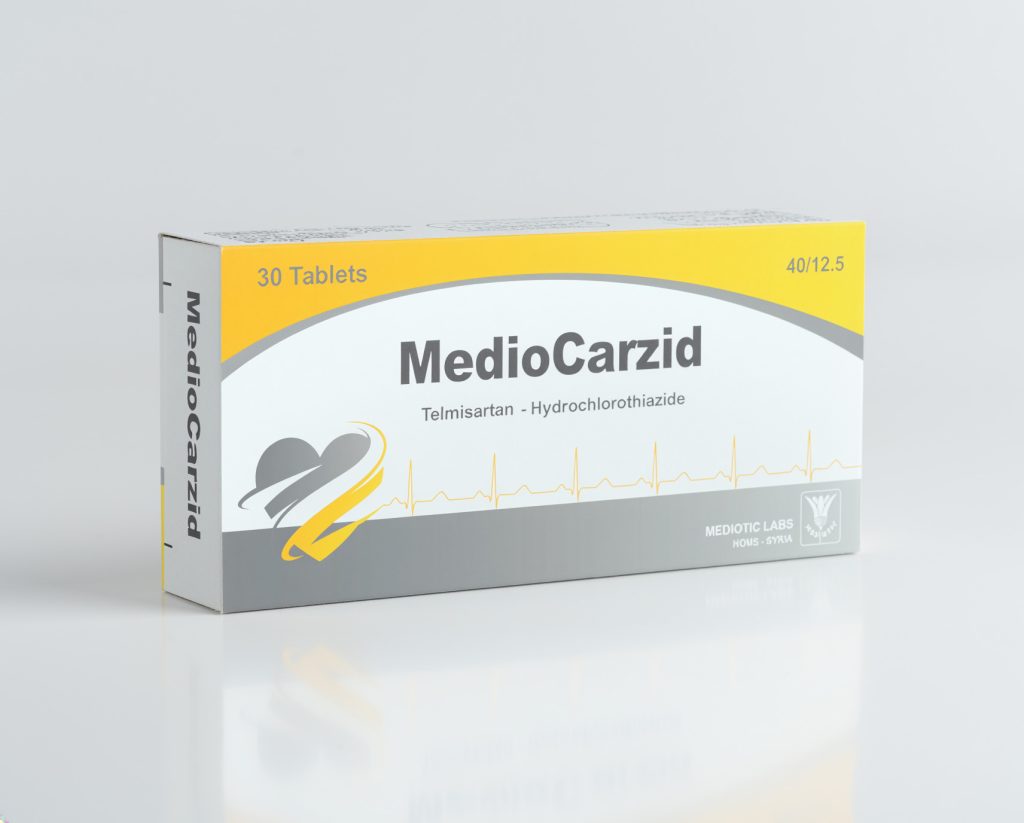
MEDIOCARZID
Composition : Telmisartan 40mg+Hydrochlorothiazide 12.5mg
Pharmaceutical Forms : Tablets
Usage : Treatment of high blood pressure
Use in Pregnancy
When pregnancy is detected, Mediocarzid should be discontinued as soon as possible.
(See warnings: fetal/ neonatal morbidity and mortality).
Composition:
Each Mediocarzid tablet contains 40 mg Telmisartan & 12.5 mg Hydrochlorothiazide.
Pharmacological Properties:
Mediocarzid is a combination of a non-peptide angiotensin II receptor (type AT1) antagonist, Telmisartan, and a thiazide diuretic, Hydrochlorothiazide. The combination of these ingredients has an additive antihypertensive effect, reducing blood pressure to a greater degree than each component alone.
Angiotensin II is the principal pressor agent of the renin-angiotensin system, with effects that include vasoconstriction, stimulation of synthesis and release of aldosterone, cardiac stimulation, and renal re-absorption of sodium.
Telmisartan blocks the vasoconstrictor and aldosterone-releasing effects of angiotensin II by selectively blocking the binding of angiotensin II to AT1 receptors in many tissues, such as vascular smooth muscles and the adrenal gland. Its action is therefore independent of the pathways for angiotensin II synthesis.
The diuretic action of Hydrochlorothiazide reduces plasma volume, increases plasma renin activity, increases aldosterone secretion, with consequent increases in urinary potassium and bicarbonate loss, and decreases in serum potassium.
Presumably through blockade of the renin-angiotensin-aldosterone system, co- administration of Telmisartan tends to reverse the potassium loss associated with these diuretics.
With Hydrochlorothiazide, onset of diuresis occurs in 2 hours, and peak effect occurs at about 4 hours, while the action persists for approximately 6-12 hours.
Pharmacokinetics:
Telmisartan:
Following oral administration, peak concentrations of telmisartan are reached in 0.5 1 hour after dosing.
The absolute bioavailability of telmisartan is dose dependent. At 40 and 160 mg the bioavailability was 42% and 58%. Food slightly reduces the bioavailability of Telmisartan.
Telmisartan shows a terminal elimination half-life of approximately 24 hours. Most of the administered dose (>97%) was eliminated unchanged in feces via biliary excretion; only small amounts were found in the urine (0.91%). Telmisartan is highly bound to plasma proteins (>99.5%) mainly albumin and a 1- acid glycoprotein.
The pharmacokinetics of telmisartan do not differ between the elderly and those younger than 65 years so no dosage adjustment is necessary. Hydrochlorothiazide:
Following oral administration, peak concentrations are reached in 1-3 hours after dosing.
Based on cumulative renal excretion of hydrochlorothiazide the absolute bioavailability was about 60%..
Hydrochlorothiazide is 64% protein bound in plasma.
It shows a terminal elimination half-life of 10-15 hours. Most of the administered dose (>60%) is eliminated unchanged in urine within 48 hours.
Indications:
Mediocarzid is indicated for the treatment of essential hypertension. Mediocarzid is indicated in patients whose blood pressure is not adequately controlled by Telmisartan or Hydrochlorothiazide alone
Contraindications:
–Hypersensitivity to the active ingredients, to any of the excipients, or to other sulphonamide-derived substances (hydrochlorothiazide is a sulphonamide- derived substance).
Second and third trimesters of pregnancy and lactation.
Cholestasis and biliary obstructive disorders
Severe hepatic impairment
Severe renal impairment (creatinine clearance 30
Refractory hypokalaemia or hypercalcaemia
Warnings:
Fetal/neonatal morbidity and mortality:
ml/min) When pregnancy is detected Mediocarzid tablets should be discontinued as soon as possible. The use of drugs that act directly on the renin-angiotensin system during the second and third trimesters of pregnancy has been associated with fetal and neonatal injury.
It is not known whether telmisartan is excreted in human milk but because of the potential for adverse effects on the nursing infant, a decision should be made whether to discontinue nursing or discontinue the drug, taking into account the importance of the drug to the mother.
Precautions:
Impaired hepatic function: As the majority of telmisartan is eliminated by biliary excretion, patients with biliary obstructive disorders or hepatic Insufficiency can be expected to have reduced clearance. Mediocarzid tablets should be used with caution in these patients.
Symptomatic hypotension may occur after initiation of treatment with Mediocarzid in patients with volume and/ or sodium-depletion by vigorous diuretic therapy, dietary salt restriction, diarrhea or vomiting. Such condition should be corrected prior to administration of Mediocarzid tablets. Caution should be taken in patients whose renal function may depend on the activity of the renin-angiotensin-aldosterone system (e.g., patients with sever congestive heart failure or renal disorders including renal artery stenosis). Because treatment with angiotensin receptor antagonists can be associated in these conditions with acute hypotension, oliguria, and/or progressive azotemia and (rarely) with acute renal failure.
Metabolic and endocrine effects: Thiazide therapy may impair glucose tolerance. In diabetic patients dosage adjustments of insulin or oral hypoglycaemic agents may be required. Latent diabetes mellitus may become manifest during thiazide therapy. Increase in cholesterol and triglyceride levels have been associated with thiazide diuretic therapy; however, at the 12.5 mg dose contained in Mediocarzid, minimal or no effects were reported. Hyperuricaemia may occur or frank gout may be precipitated in some patients receiving thiazide therapy. Electrolyte imbalance: As for any patient receiving diuretic therapy, periodic determination of serum electrolytes should be performed at appropriate intervals. Thiazides, including hydrochlorothiazide, can cause fluid or electrolyte imbalance (hypokalaemia, hyponatramia, and hypochloraemic alkalosis). Warning signs of fluid or electrolyte imbalance are dryness of mouth, thirst, weakness, lethargy, drowsiness, restlessness, muscle pain or cramps, muscular fatigue, hypotension, oliguria, tachycardia, and gastro-intestinal disturbances such as nausea or vomiting.
Thiazides may decrease urinary calcium excretion and cause an intermittent and slight elevation of serum calcium.
Ability to drive and operating machines: It must be borne in mind that dizziness or drowsiness may occasionally occur when taking antihypertensive therapy.
Drug Interactions:
Co-administration of lithium and Mediocarzid may result in a reversible increase of serum lithium concentrations.
Potentiation of the antihypertensive effect may occur when Mediocarzid is given in commitant with: alcohol, barbiturates, narcotics, antidepressants, amifostine.
Periodic monitoring of serum potassium and ECG is recommended when Mediocarzid is administered with drugs affected by serum potassium disturbances such as: digoxin, antiarrhythmics, some antipsychotics. Telmisartan increases the antihypertensive effect of other antihypertensives. In diabetic patients, the dosage of insulin or oral antidiabetic agents may need adjustment during Mediocarzid therapy.
Non steroidal anti-inflammatory drugs may reduce the diuretic, natriuretic and antihypertensive effects of thiazide diuretics.
Side effects:
There was no dose-relationship to undesirable effects and there was no correlation with gender or age of the patient.
The common side effects: upper respiratory tract infections including pharyngitis and sinusitis, urinary tract infections, gastritis, diarrhea, dyspepsia, gastrointestinal disorders, skin disorders, arthrosis, back pain, myalgia, anxiety, dizziness and influenza like symptoms.
Dosage & administration:
Adults:
Take one Mediocarzid tablet once daily.
Mediocarzid may be administered with another antihypertensive drug.
It can be taken with or without food.
The maximum antihypertensive effect is generally attained with Mediocarzid 4-8 weeks after the start of treatment.
Elderly:
No dosage adjustment is necessary.
Children and adolescents:
Safety and efficacy of Mediocarzid have not been established in children and in adolescents up to 18 years.
Overdose:
The patient should be closely monitored, and the treatment should be symptomatic and supportive. Suggested measures include induction of emesis and/ or gastric lavage. Activated charcoal may be useful in the treatment of overdose.
If hypotension occurs, the patient should be placed in a supine position, with salt and volume replacements given quickly.
The most likely manifestations of telmisartan overdose are expected to be hypotension and tachycardia; bradycardia might also occur.
Overdose with hydrochlorothiazide is associated with electrolyte depletion and dehydration resulting from excessive diuresis. The most common symptoms are nausea and somnolence, muscle spasm and/ or accentuate cardiac arrhythmias.
Storage: Store below 25°C, out of reach of children.
Presentation: Box contains: 30 tablets.
Related Products.
- New
EXOZIDE 160/25
- New
SOTAL 120
- New
SPERIL

- New
ABILY 15

- New
Rebaglinide mediotic0.5 mg
- New