

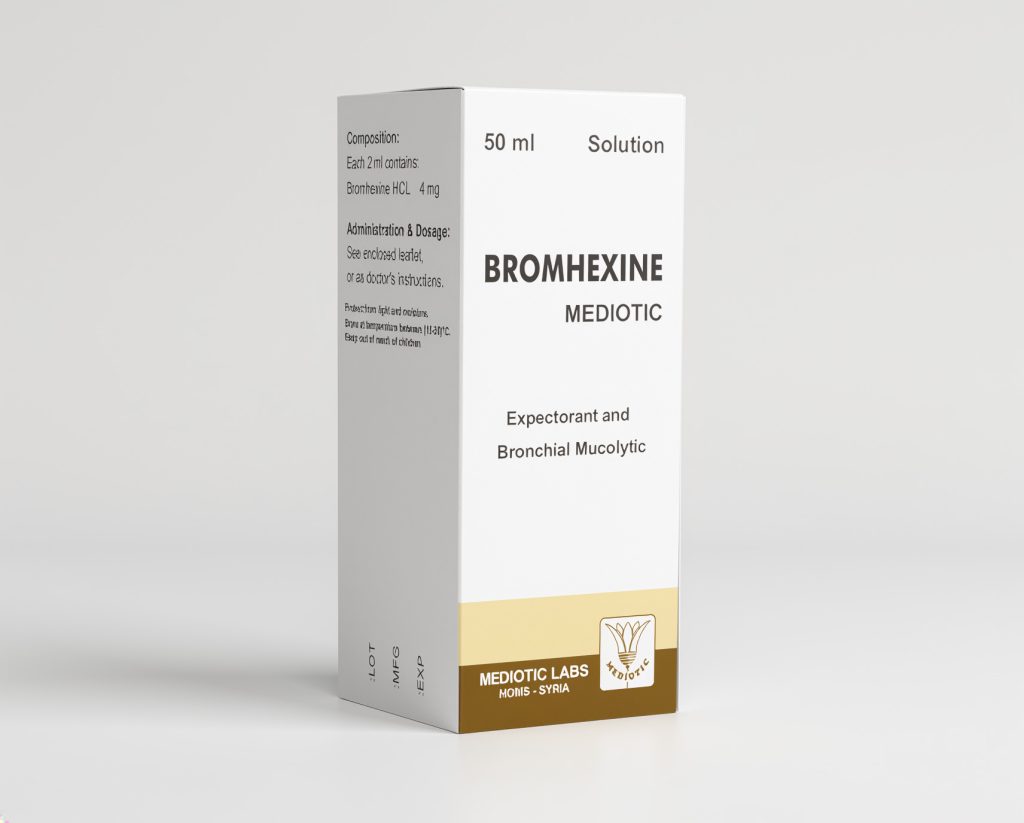
BROMEXINE
Composition : Bromhexine HCL 2mg/ml
Pharmaceutical Forms : Oral & Nasal Drops
Usage : Expectorant and mucolytic
Properties:
Bromhexine acts within the bronchial mucous glands causing the fragmentation of the acid mucopolysaccharide fibers which are mainly responsible of increasing the viscosity of the bronchial secreta so Bromhexine leads to an easier expectoration.
Indications:
Bromhexine is used as an expectorant.
Bromhexine is used in conditions accompanied with excessive mucoid secreta.
Bromhexine is indicated for pneumonic bronchial diseases accompanied with increasing of the mucous secretion like in bronchitis.
Precautions:
– Bromhexine should be given cautiously to patients with gastric ulceration, renal and hepatic failure.
– Bromhexine should be given cautiously to pregnant mothers and it should not be given during lactation.
Drug Interactions:
It increases the antibiotic concentration in pneumonic tissues when associated with it.
Side Effects:
More common reactions: nausea, diarrhea, indigestion, and abdominal fullness.
Less common reactions: headache, vertigo, perspiration, and skin rash. Gastrointestinal side effects may occur occasionally, and a transient rise in serum aminotransferase may occur.
However, there is no need to discontinue using Bromhexine if any of these side effects occur.
Contraindications:
Bromhexine is contraindicated in patients with hypersensitivity to Bromhexine Hydrochloride.
Dosage & Administration:
Adults: One tablet 3 times daily.
1-2 tablespoon 3 times daily.
Children: 2-6 years: 1⁄2 teaspoon 3 times daily. 6-12 years: One teaspoon 3 times daily.
Storage:
Over 12 years: One tablespoon 3 times daily.
– Keep in temperature between (15-30)°C.
– Keep away from light and moisture.
– Keep away from Children.
Presentation:
Tablets: Carton box contains 2 blisters, each one contains 10 tablets. Solution: Plastic Bottle contains 50 ml.
Related Products.
- New
SPASMO-STOP

- New