

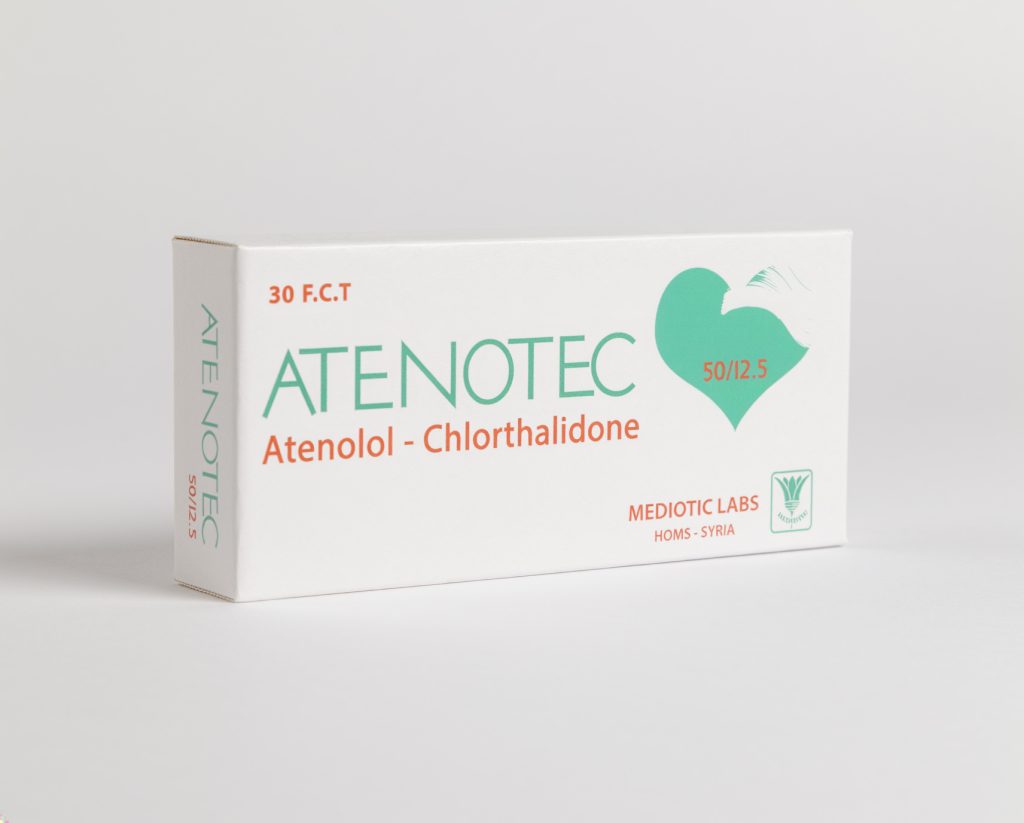
ATENOTEC 50/12.5
Composition : Atenolol 50 mg+12.5mg chlorthalidone
Pharmaceutical Forms : Tablets
Usage : Antihypertensive + diuretic
Atenolol / Chlorthalidone (Film Coated Tablets)
Atenolol 50 mg/ Chlorthalidone 12.5 mg or Atenolol 100 mg/ Chlorthalidone 25 mg. Excipients:Maize starch,calcium hydrogen phosphste,microcrystalline
cellulose, povidone,sodium starch glycollate,magnesium stearate.
Film coate:Pink opadry.
Pharmacological properties:
Pharmacotherapeutic group: Beta-blocking agents, selective, and other diuretics.
This product tablets combine the antihypertensive activity of two agents, a beta-blocker (atenolol) and a diuretic (Chlorthalidone).
Atenolol:
Atenolol is beta1-selective (i.e. acts preferentially on beta1-adrenergic receptors in the heart). Selectivity decreases with increasing dose.
Atenolol is without intrinsic sympathomimetic and membrane-stabilising activities and, as with other beta-adrenoceptor- blocking drugs, has negative inotropic effects (and is therefore contraindicated in uncontrolled heart failure).
As with other beta-blockers, the mode of action in the treatment of hypertension is unclear.
It is unlikely that any additional ancillary properties possessed by S (-) atenolol, in comparison with the racemic mixture, will give rise to different therapeutic effects.
Atenolol is effective and well-tolerated in most ethnic populations. Black patients respond better to the combination of atenolol and Chlorthalidone, than to atenolol alone.
The combination of atenolol with thiazide-like diuretics has been shown to be compatible and generally more effective than either drug used alone.
Chlorthalidone:
Chlorthalidone, a monosulfonamyl diuretic, increases excretion of sodium and chloride.
Natriuresis is accompanied by some loss of potassium. The mechanism by which Chlorthalidone reduces blood pressure is not fully known but may be related to the excretion and redistribution of body sodium.
Pharmacokinetic properties:
Atenolol:
Absorption of atenolol following oral dosing is consistent but incomplete (approximately 40-50%) with peak plasma concentrations occurring 2-4 hours after dosing. The atenolol blood levels are consistent and subject to little variability.
There is no significant hepatic metabolism of atenolol and more than 90% of that absorbed reaches the systemic circulation unaltered. The plasma half-life is about 6 hours but this may rise in severe renal impairment since the kidney is the major route of elimination. Atenolol penetrates tissues poorly due to its low lipid solubility and its concentration in brain tissue is low. Plasma protein binding is low (approximately 3%).
Chlorthalidone:
Absorption of Chlorthalidone following oral dosing is consistent but incomplete (approximately 60%) with peak plasma concentrations occurring about 12 hours after dosing. The Chlorthalidone blood levels are consistent and subject to little variability. The plasma half-life is about 50 hours and the kidney is the major route of elimination. Plasma protein binding is high (approximately 75%). Coadministration of Chlorthalidone and atenolol has little effect on the pharmacokinetics of either. This product tablets are effective for at least 24 hours after a single oral daily dose. This simplicity of dosing facilitates compliance by its acceptability to patients.
Indications:
Management of hypertension.
Dosage:
Adults: One tablet daily.
Elderly:
One tablet daily. The elderly with hypertension who do not respond to low dose therapy with a single agent should have a satisfactory response to a single tablet daily of Tenoret. Where hypertensive control is not achieved, addition of a small dose of a third agent e.g. as a vasodilator, may be appropriate.
Pediatric population:
The use of This product is not recommended in children. The safety and efficacy of This product in children has not yet been established.
Renal Impairment:
Due to the properties of the Chlorthalidone component, This product tablets has reduced efficacy in the presence of renal insufficiency. This fixed dose combination should thus not be administrated to patients with severe renal impairment.
Contraindications:
This product tablets should not be used in the following:
– Hypersensitivity to the active substances (or to sulphonamide derived medicinal products) or to
any of the excipients.
Bradycardia.
– Cardiogenic shock.
– Hypotension.
– Metabolic acidosis.
– Severe peripheral arterial circulatory disturbances.
Second- or third-degree heart block.
– Sick sinus syndrom e.
– Untreated phaeochromocytoma.
–Severe renal failure.
– Uncontrolled heart failure.
This product tablets must not be given during pregnancy or lactation.
Warnings and precautions:
Due to its beta-blocker component (Atenolol ):
Although contraindicated in uncontrolled heart failure may be used in patients whose signs of heart failure have been controlled. Caution must be exercised in patients whose cardiac reserve is poor.
May increase the number and duration of angina attacks in patients with Prinzmetal’s angina due to unopposed alpha receptor mediated coronary artery vasoconstriction. Atenolol is a beta1- selective beta-blocker; consequently the use of This product tablets may be considered although utmost caution must be exercised.
– Although contraindicated in severe peripheral arterial circulatory disturbances may also aggravate less severe peripheral arterial circulatory disturbances.
– Due to its negative effect on conduction time, caution must be exercised if it is given to patients with first-degree heart block.
May modify warning signs of hypoglycaemia as tachycardia, palpitation and sweating. May mask the cardiovascular signs of thyrotoxicosis.
Will reduce heart rate, as a result of its pharmacological action. In the rare instances when a treated patient develops symptoms which may be attributable to a slow heart rate, the dose may be reduced.
-Should not be discontinued abruptly in patients suffering from ischaemic heart disease. May cause a more severe reaction to a variety of allergens, when given to patients with a history of anaphylactic reaction to such allergens. Such patients may be unresponsive to the usual doses of adrenaline used to treat the allergic reactions.
– May cause a hypersensitivity reaction including angioedema and urticaria.
– Patients with bronchospastic disease should, in general, not receive beta-blockers due to increasing in airways resistance. Atenolol is a beta1-selective beta-blocker; however this selectivity is not absolute. Therefore the lowest possible dose of This product tablets should be used and utmost caution must be exercised. If increased airways resistance does occur, This product tablets should be discontinued and bronchodilator therapy (e.g. salbutamol) administered if necessary.
The patient information leaflet for this product states the following warning:
“If you have ever had asthma or wheezing, do not take this medicine without first checking with your doctor”.
Systemic effects of oral beta-blockers may be potentiated when used concomitantly with ophthalmic beta-blockers.
– In patients with phaeochromocytoma must be administered only after alfa-receptor blockade. Blood pressure should be monitored closely.
– Caution must be exercised when using anaesthetic agents with This product tablets.
The anaesthetist should be informed and the choice of anaesthetic should be an agent with as little negative inotropic activity as possible.
Use of beta-blockers with anaesthetic drugs may result in attenuation of the reflex tachycardia and increase the risk of hypotension.
Anaesthetic agents causing myocardial depression are best avoided.
Due to its Chlorthalidone component:
– Plasma electrolyte should be periodically determined in appropriate intervals to detect possible electrolyte imbalance especially hypokalaemia and hyponatraemia.
Hypokalaemia and hyponatraemia may occur. Measurement of electrolytes is recommended, especially in the older patient, those receiving digitalis preparations for cardiac failure, those taking an abnormal (low in potassium) diet or those suffering from gastrointestinal complaints. Hypokalaemia may predispose to arrhythmias in patients receiving digitalis.
– Impaired glucose tolerance may occur and diabetic patients should be aware of the potential for increased glucose levels. Close monitoring of glycaemia is recommended in the initial phase of therapy and in prolonged therapy test for glucosuria should be carried out at regular intervals. – In patients with impaired hepatic function or progressive liver disease, minor alterations in fluid and electrolyte balance may precipitate hepatic coma.
Hyperuricaemia may occur. Only a minor increase in serum uric acid usually occurs but in cases of prolonged elevation, the concurrent use of a uricosuric agent will reverse the hyperuricaemia.
Interaction:
Due to atenolol:
Combined use of beta-blockers and calcium channel blockers with negative inotropic effects e.g. verapamil, diltiazem, can lead to an exaggeration of these effects particularly in patients with impaired ventricular function and/or sino-atrial or atrio-ventricular conduction abnormalities. This may result in severe hypotension, bradycardia and cardiac failure.
Neither the beta-blocker nor the calcium channel blocker should be administered intravenously within 48 hours of discontinuing the other.
Class I anti-arrhythmic drugs (e.g. disopyramide) and amiodarone may have a potentiating effect on atrial-conduction time and induce negative inotropic effect.
Digitalis glycosides, in association with beta-blockers, may increase atrio-ventricular conduction time.
Beta-blockers may exacerbate the rebound hypertension which can follow the withdrawal of clonidine. If the two drugs are co-administered, the beta-blocker should be withdrawn several days before discontinuing clonidine. If replacing clonidine by beta-blocker therapy, the introduction of beta-blockers should be delayed for several days after clonidine administration has stopped.
Concomitant use of sympathomimetic agents, e.g. adrenaline (epinephrine), may counteract the effect of beta-blockers.
Concomitant use of prostaglandin synthetase inhibiting drugs (e.g. ibuprofen, indometacin) may decrease the hypotensive effects of beta-blockers
Caution must be exercised when using anaesthetic agents with This product tablets.
Due to Chlorthalidone:
The Chlorthalidone component may reduce the renal clearance of lithium leading to increased serum concentrations. Dose adjustments of lithium may therefore be necessary.
Concomitant use with insulin and oral antidiabetic drugs may lead to the intensification of the blood sugar lowering effects of these drugs.
Due to the combination product:
Concomitant therapy with dihydropyridines e.g. nifedipine, may increase the risk of hypotension, and cardiac failure may occur in patients with latent cardiac insufficiency.
Concomitant use of baclofen may increase the antihypertensive effect making dose adjustments necessary.
Pregnancy:
This product tablets must not be given during pregnancy.
Lactation:
This product tablets must not be given during lactation. Effects on ability to drive and use machines
Use is unlikely to result in any impairment of the ability of patients to drive or use machinery. However, it should be taken into account that occasionally dizziness or fatigue may occur. Undesirable effects
This product tablets are well tolerated. In clinical studies, the undesired events reported are usually attributable to the pharmacological actions of its components.
System Organ Class
Psychiatric disorders
Frequency Uncommon
Adverse Drug Reaction
Sleep disturbances of the type noted with other beta-blockers
Bradycardia
Cardiac disorders
Common
Vascular disorders
Common
Cold extremities
Gastrointestinal disorders
Common
Not known
Not known
Gastrointestinal disturbances (including nausea related to Chlorthalidone)
Constipation
Hypersensitivity reactions, including
angioedema and urticaria
Musculoskeletal and connective
Not known
Lupus-like syndrome
tissue disorders
General disorders and
Common
Fatigue
administration site conditions
Investigations
Common
Related to Chlorthalidone:
Uncommon
Hyperuricaemia,
hyponatraemia, hypokalaemia, impaired glucose tolerance
Elevations of transaminase levels.
Discontinuance of This product tablets should be considered if, according to clinical judgement, the well-being of the patient is adversely affected by any of the above reactions. Overdose:
The symptoms of overdosage may include bradycardia, hypotension, acute cardiac insufficiency and bronchospasm.
General treatment should include: close supervision, treatment in an intensive care ward, the use of gastric lavage, activated charcoal and a laxative to prevent absorption of any drug still present in the gastrointestinal tract, the use of plasma or plasma substitutes to treat hypotension and shock. The possible use of haemodialysis or haemoperfusion may be considered. Packaging:Atenotec (50/12.5)3blisters in carton box, each blister contains 10 F.C.T.
Atenotec (100/25)3blisters in carton box,each blister contains 10 F.C.T. Storage conditions: Store at room temperature below 25°C,away from moisture.
Related Products.
- New
ATENOTEC 100/25
- New
Rebaglinide mediotic0.5 mg
- New
ASMANOL 5
- New
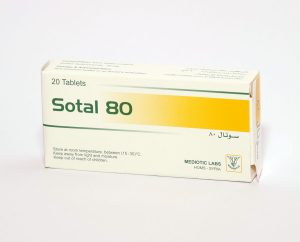
SOTAL 80
- New
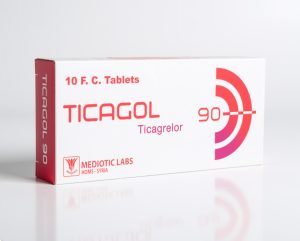
TICAGOL 90
- New