

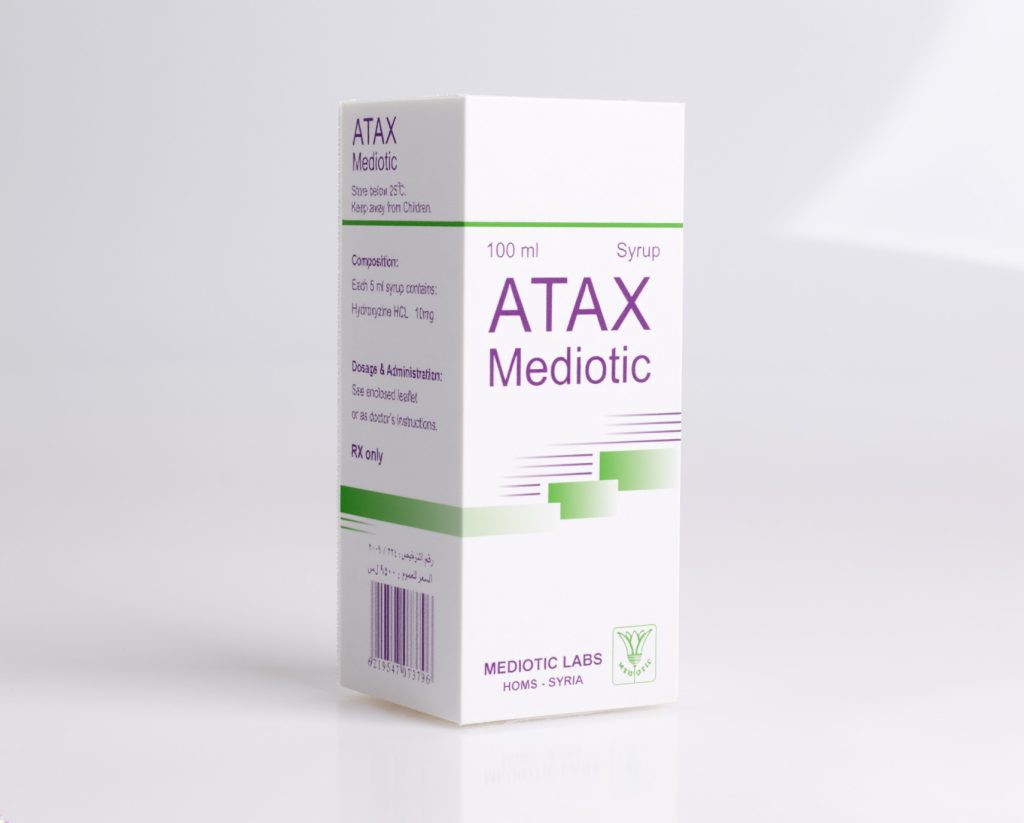
ATAX
Composition : Hydroxyzine Hcl 10mg/5ml
Pharmaceutical Forms : Syrup & Oral Suspension
Usage : Anti-allergic and anti-pruritic
Hydroxyzine HCL is not a cortical depressant, but its action may be due to a suppression of activity in certain key regions of the subcortical area of the central nervous system. Primary skeletal muscle relaxation, bronchodilator activity, antihistaminic, analgesic and antiemetic effects have been demonstrated experimentally and confirmed clinically.
Clinical studies indicate that Hydroxyzine HCL in therapeutic dosage does not increase gastric secretion nor acidity, and in most cases has mild antisecretory activity. Hydroxyzine HCL is rapidly absorbed from the gastrointestinal tract and It’s clinical effects are usually noted within 15-30 minutes after oral administration. Indications:
For symptomatic relief of anxiety and tension associated with psychoneurosis and as an adjunct in organic disease states in which anxiety is manifested.
– Useful in the management of pruritus due to allergic conditions such as chronic urticaria and atopic and contact dermatoses, and in histamine-mediated pruritus. As a sedative when used as premedication and following general anesthesia. Contra-Indications:
Hydroxyzine HCL is contraindicated for patients who have shown a previous hypersensitivity to it.
Pregnancy & lactation:
Clinical data in human beings are inadequate to establish safety in early pregnancy. Until such data is available, Hydroxyzine HCL is contraindicated in early pregnancy. Nursing Mothers: It is not known whether this drug is excreted in human milk. Since many drugs are so excreted, this medication should not be given to nursing mothers. Precautions:
The potentiating action of Hydroxyzine HCL must be considered when the drug is used in conjunction with central nervous system depressants such as narcotics, non- narcotic analgesics and barbiturates, Therefore when central nervous system depressants are administered concomitantly with Hydroxyzine HCL their dosage should be reduced.
Since drowsiness may occur with use of this drug, patients should be warned of this possibility and cautioned against driving a car or operating dangerous machinery while taking this medication.
Patients should be advised against the simultaneous use of other CNS depressant drug, and cautioned that the effect of alcohol may be increased.
Adverse reactions:
Side effects reported with the administration of this medication are usually mild and transitory in nature.
The most common side effects: dry mouth and drowsiness.
Respiratory depression, involuntary motor activity including tremor and convulsions have been reported, usually with doses considerably higher than those recommended. Overdosage:
The most common manifestation of this medication overdosage is hypersedation.
If vomiting has not occurred spontaneously, it should be induced. Immediate gastric lavage is also recommended.
General supportive care, including frequent monitoring of the vital signs and close observation of the patient, is indicated.
Dosage & Adminstration:
For symptomatic relief of anxiety and tension in:
Children under 6 years: 50 mg daily in divided doses. Childers over 6 years: 50 – 100 mg in divided doses.
Adults: 50 100 mg (4 times daily).
For use in the management of pruritus due to allergic conditions:
Children under 6 years: 50 mg in divided doses.
Children over 6 years: 50 – 100 mg daily in divided doses.
Adults: 25 mg (3 or 4 times daily).
As a sedative when used as a premedication and following general anesthesia: 50 100 mg in adults, and 0.6 mg/kg in children.
As with all medications, the dosage should be adjusted according to the patient’s response to therapy.
Storage:
Store below 25 °C.
Do not despense without a medical prescription.
Presentation:
– ATAX-Mediotic tablets: 2 blisters each one contians 10 coated tablets / carton box.
– ATAX-Mediotic syurp: Glass bottle of 100ml / carton box.
Related Products.
- New
MEDIOPROFEN
- New
CYPROHEPTADINE
- New
FLOMAZOL
- New
MEDIOFURYL
- New
ASMANOL
- New